Broad Soft

  • Subscribe to our RSS feed.
  • Twitter
  • StumbleUpon
  • Reddit
  • Facebook
  • Digg

Wednesday, 14 August 2013

Nobody Knows What Will Happen to Service Provider Revenue Once Major Video Cord Cutting Happens, Really

Posted on 14:10 by Unknown
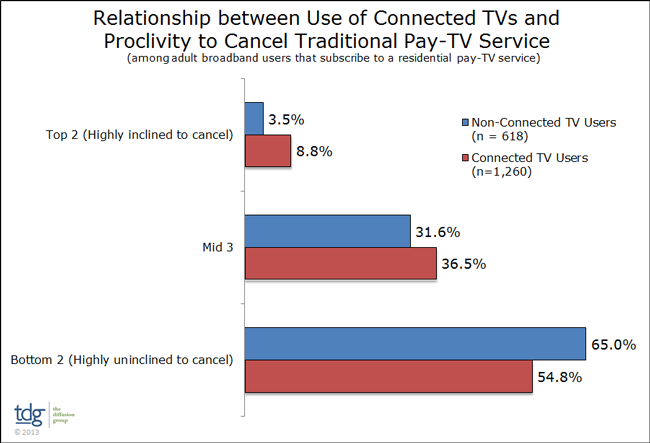
Adult broadband users with an Internet-connected TV are twice as likely as those with non-net-connected TVs to be “highly inclined” to cancel their current subscription video service, according to a new report from The Diffusion Group (TDG Research).


Those findings likely would not come as a surprise to anybody who normally watches developments in the video entertainment business. It is a trusim that a person cannot become a user or customer of any product unless that person is physically able to purchase or use.

So it should not be a great surprise that when able to view Internet-delivered TV on a big screen TV, some users might decide they can do without a video subscription. Without the ability to view Internet-delivered video, a person has no option to consider whether that experience is a reasonably workable substitute for a video subscription.

To be sure, most people probably would simply augment what they already do, and add some Internet sourced TV to their broadcast TV or video subscription or other home video sources such as Blu-ray players.

But perhaps seven percent of consumers, at any given time, might be interested in abandoning their video subscriptions for some sort of over the top or broadcast TV alternative, TDG Research suggests.

Some 8.8 percent of connected TV users say they are highly inclined to cancel their current subscription TV service in the next six months, compared with only 3.5 percent of non-net-connected TV users, TDG Research says.

Virtually no executives whose firms are major providers of subscription video services would argue it makes no difference to their revenues were widespread abandonment of subscription TV to be replaced by widespread viewing of over the top alternatives.

On the other hand, assuming they are not forced to offer low-cost “unlimited” service where there is no matching of usage to retail price, watching more over the top television is going to create demand for orders of magnitude more bandwidth.

So yes, service providers will lost a big chunk of video revenue. But they will gain a big chunk of Internet access revenue. Or so the logic might suggest.

The stumbling block, and it is a serious problem, is a shift of rival major competitors to something like Google Fiber’s pricing and usage plans: unlimited usage of a 1 Gbps symmetrical Internet access service, for $70 a month.

That would wreck most tier-one service provider revenue models, in the event of a major drop in video subscriptions, and an equally big shift to over the top services using Internet delivery.

There is one more huge issue as well. In addition to spending more for Internet access, consumers will still be paying for the TV programs or channels they want. When all the costs are added up, it is not entirely clear that the total cost of ownership will be dramatically less than what they already pay.

The conventional wisdom is that cable companies and telcos will be savaged on the revenue front when a widespread shift to over the top delivery begins. That isn’t necessarily the case.

Much depends on consumer demand. Heavier video entertainment users might find it costs less to keep buying linear TV services. Moderate users might find net costs roughly the same. Lighter users, though, probably would be best positioned to achieve savings.
Email ThisBlogThis!Share to XShare to Facebook
Posted in | No comments
Newer Post Older Post Home

0 comments:

Post a Comment

Subscribe to: Post Comments (Atom)

Popular Posts

  • Seattle's Gigabit Squared Fails: Sustainability Remains an Issue for Muni Access Networks
    Seattle's Gigabit Squared  network appears to have failed, illustrating a recurring problem with all municipal or joint venture Internet...
  • Access Networks Increasingly are All About Video
    In North America, r eal-time entertainment is responsible for over  68 percent of downstream bytes during peak periods, compared to 65 perce...
  • Using a Drone-Mounted Camera to See what a Surfer Sees "In the Water"
    If you've ever seen a picture of a surfer (the ocean kind), shot from shore, you have one view of what's going on, but you can't...
  • New Report Confirms: Investment or Competition is a Real Issue for Access Networks
    The latest Ofcom report on U.K. broadband infrastructure illustrates the inherent tension between promoting investment in next generation ne...
  • Google Fiber in Provo Prices Same as Kansas City
    Google Fiber  in Provo, Utah will be priced the same way as Google Fiber in Kansas City. People will be able to sign up for free 5 Mbps down...
  • EC to Review Telefonica, E-Plus Merger: How Many Carriers are Needed in Germany?
    European Union antitrust regulators will examine deals such as the proposal by Telefonica and Royal KPN to combine their German assets, base...
  • AT&T Tower Sale Raises, Does Not Answer, Question of "Core Competency"
    What is AT&T’s “core competency?” That is a question observers might raise, in the wake of AT&T’s decision to sell its U.S. mobile t...
  • How Big a Phone Will You Carry All the Time?
    How big a device will you carry with you, all the time, like you carry a mobile phone? Samsung Mega is going to provide some real-world tes...
  • To Attack U.S. Mobile Pricing Structure, Sprint and T-Mobile US Will Have to AddressTheir Own Cost Structures
    If a mobile service provider wants to attack prevailing retail prices in a serious way, it also has to attack its own operating and possibly...
  • Market Disruption is a Game Verizon Can Play as Well
    One often tends to think that big market disruptions are caused by small, upstart firms. History might suggest something quite different. Y...

Blog Archive

  • ►  2014 (23)
    • ►  January (23)
  • ▼  2013 (476)
    • ►  December (83)
    • ►  November (79)
    • ►  October (127)
    • ►  September (95)
    • ▼  August (92)
      • Verizon, Vodafone Making Different Bets on Market ...
      • What Happened to Free Speech in the U.S.?
      • Mobile Spending Now 10% of all E-Commerce
      • Tablets Might be Fastest-Growing Consumer Electron...
      • Will Vodafone Survive Verizon Wireless Sale?
      • AT&T’s Contract-Free Prepaid Aio Service Goes Nati...
      • America Movil Encounters Obstacle in Effort to Buy...
      • Three U.K. Offers Domestic Tariffs for Roaming Cal...
      • Gigablit Libraries Network to Test TV White Spaces...
      • Slovakia Begins 4G Spectrum Auction
      • EC Digital Commissioner Backs Off 90% Roaming Rate...
      • Skype Marks 10th Anniversary
      • Will Verizon Sell its Fixed Network, After Buying ...
      • Comcast to Launch 250 Mbps in Provo for $80 a month
      • Debate over "Fiber to Home" Versus "Fiber to Node"...
      • Will End of Moore's Law Impair ISP Ability to Rapi...
      • 90% of Republic Wireless Traffic Moves Over Wi-Fi
      • Cox Communications Offers Wi-Fi Hotspot Access
      • Why U.S. Cable and Telcos are Chasing Home Automat...
      • Africa Might be Among the Best Places for Fast Int...
      • Google Names Top U.S. "eCities"
      • "Net Neutrality" Will Kill the Teleconm Business
      • 20% of U.S. Residents "Can't Get" Broadband, or "D...
      • Mobile Revenue: Voice 21%. Where's the Rest?
      • Wi-Fi is Valuable for a Service Provider, Just Har...
      • Broadband Now IS Internet Access
      • Telefonica, America Movil Both Covet the German Ma...
      • The Difference Between 2000 and 2013
      • Will LTE Displace Public Wi-Fi?
      • Licensed Wi-Fi?
      • While LightSquared Lawsuit Remains Unresolved, So ...
      • 10% of U.K. 5-Year-Olds have Mobile Phones
      • How 1 Philippines Telco Monetizes Over the Top Mes...
      • Amazon Weighing its Own Mobile Network?
      • Google Project Loon (Internet by Balloon) Continue...
      • Are Mobile Networks a Viable Substitute for Fixed ...
      • Why Over the Top TV Won't Necessarily Save You Money
      • More Book Reading on Smart Phones than Tablets, St...
      • Amazon is 5X Bigger Than All Other Cloud Vendors C...
      • Czech 4G Auctions Coming in November 2013
      • OTT Messaging is Not Cannibalizing Text Messaging,...
      • Will You Save Money Buying Future Online TV?
      • Bundles Lift Revenue per Customer, Drive Revenue G...
      • Despite Earlier Denials, Apple Will Ship a Low-Cos...
      • Smart Phones Will Close Digital Divide Globally
      • Video Business Loses Customers, Again
      • Skype Now Available from Inside Outlook.com
      • 10 Firms Win Parts of $10 Billion U.S. Interior De...
      • How Big a Phone Will You Carry All the Time?
      • China Aims for 50 Mbps in Cities by 2020
      • Cloud Computing Nears "Trough of Disillusionment"
      • Alteva, Frontier, Windstream Show Transformation S...
      • If the Windows Operating System Were a House, It W...
      • U.S. Licensed and Unlicensed Use of White Spaces H...
      • About 66% of Mobile Data is Offloaded to Wi-Fi
      • FCC Says It Will Not "Automatically" Allow Verizon...
      • Telekom Austria Wants to Buy Serbia Broadband
      • NSA Spying: How Can We Trust Anything You Now Say?
      • Is Square "Western Union?"
      • TOT Delays 3G Expansion in Thailand
      • Google Fiber in Provo Prices Same as Kansas City
      • Using a Drone-Mounted Camera to See what a Surfer ...
      • Skype Will be Native Part of Windows 8.1 Start Screen
      • Technology Adoption Rates Show Danger of Getting t...
      • Content Owners Will Decide Whether Apple Really Ha...
      • Baltimore to Explore Own Internet Access Network
      • PCs are for Work, Other Than That, People Will Pre...
      • Lenovo Sells More Smart Phones, Tablets than PCs
      • DoJ Opposition to US Airways, American Airlines Me...
      • 1 Regulator or 28? Competition or Investment? Are ...
      • Nobody Knows What Will Happen to Service Provider ...
      • Smart Phones Surpass Basic Phone Sales for First T...
      • Mobile Business Now Faces "End of Growth" Driven b...
      • 7% of Surveyed Mobile Execs Think Joyn Will Succee...
      • More Consolidation in U.S. Mobile Market is an Eas...
      • How Much Will Global Telecom Revenue Grow in 2013?
      • Telekom Austria and KPN Wholesale Fiber Network a ...
      • Orange Money Expands into Retail Payments, Branded...
      • CenturyLink Touts 1 Gbps
      • Google Adds Global Spell Check, Formatting Features
      • LTE Customers Buy Bigger Data Plans, Study Finds
      • T-Mobile US Breaks Trend
      • Mobile Commerce 11% of E-Commerce in 1Q 2013
      • Telekom Austria Revenues Fall 2% in 2Q 2013
      • Can FCC Lawfully Do Anything; Should it Do Anythin...
      • Has U.S. Mobile Market Revenue Reached its Peak?
      • Security Concerns About Mobile Commerce Might be Q...
      • Leaders and Managers: Followers Create the Former,...
      • Market Disruption is a Game Verizon Can Play as Well
      • How Strategic is Ownership or Operation of an Acce...
      • Windstream Earnings Illustrate Rural Telco Problem
      • Video Cord Cutting Not Yet at the "Disruption" Phase
Powered by Blogger.

About Me

Unknown
View my complete profile