Broad Soft

  • Subscribe to our RSS feed.
  • Twitter
  • StumbleUpon
  • Reddit
  • Facebook
  • Digg

Monday, 11 November 2013

Without Small Cells, Video Conferencing and Streaming Do Not Work in Office Buildings

Posted on 07:12 by Unknown
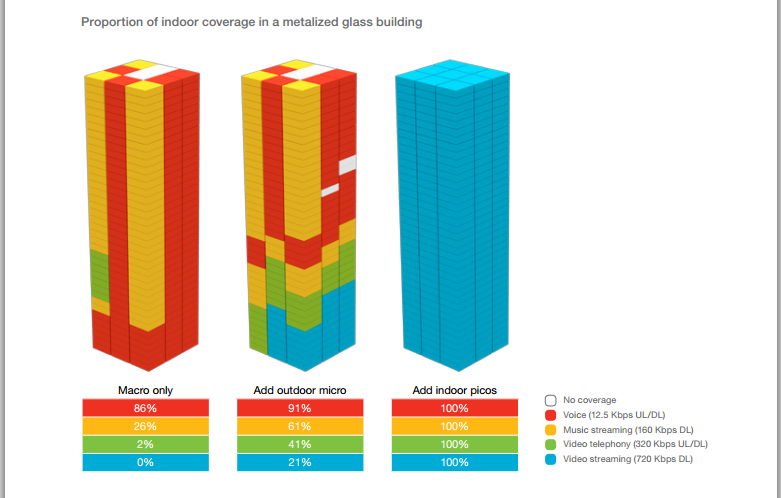
Without use of indoor mobile network cells and outdoor small cells, Internet apps such as video conferencing on smart phones might work only two percent of the time, while video streaming does not work at all.


That illustrates the dramatic impact support for Internet access on mobile devices now has on the design of mobile networks. Traditional networks were designed to support adequate voice app coverage. That doesn’t work for mobile Internet access.


Indoor application coverage is a bigger issue than voice coverage. In a high-rise office building, serviced strictly by traditional macrocells, voice service might work about 85 percent of the time, according to the Ericsson Mobility Report.

But video streaming rarely works, and video conferencing might only work about two percent of the time. Outdoor small cells will help. Adding public small cells improves video conferencing app availability to about 41 percent of locations inside a high-rise building.


Ability to use video streaming might improve to perhaps 21 percent. But coverage can, in principle, be increased to 100 percent, for all apps, when indoor pico cells also are added.


While median speeds in cities studied by Ericsson can be 10 Mbps and higher in a given cell, throughput is generally much lower at cell edge (only a few hundred kilobits per second). That is a function of signal strength, network load and device capability.

Of the cities Ericsson studied, only Copenhagen and Oslo have a 90 percent probability of getting a 1 Mbps downlink throughput or higher. In Shanghai, Jakarta, Beijing, Moscow, São Paulo, Cairo and Delhi, the corresponding speed is less than 100 Kbps.


In all of the cities studied, there is a large difference between the 10 percent (peak), 50 percent (median) and 90 percent probability downlink speeds, Ericsson notes.


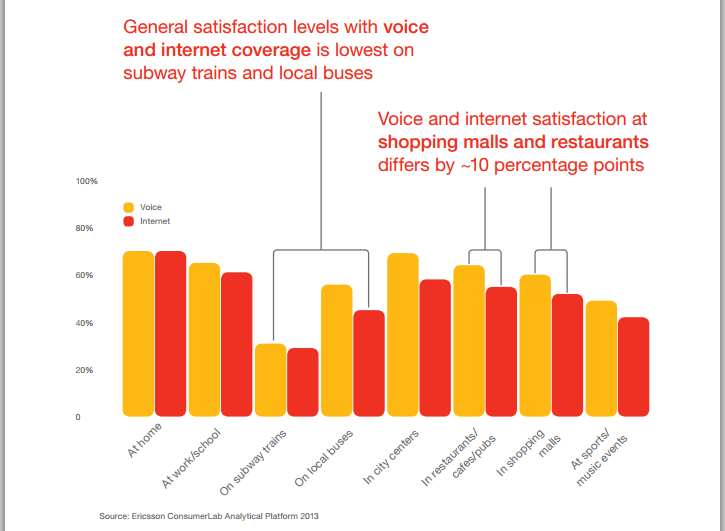
In all areas of the city, except for in the home, where Wi-Fi access often is available, Internet satisfaction is falling behind voice satisfaction.


In some cities, such as Istanbul, the difference between voice and Internet access satisfaction is extensive, varying by up to 20 percentage points in some places.


For shopping malls and restaurants, satisfaction with Internet connections is at just over
50 percent on average. In these locations there is a difference in satisfaction levels of almost 10 percentage points for voice, compared to Internet use.


In Tokyo, London and New York as many as 50 percent to 60 percent of surveyed users are dissatisfied with voice and internet on the subway, for example.


That illustrates why indoor and urban coverage is so important for mobile service providers. Internet access performance now is a clear “pain point” for consumers.


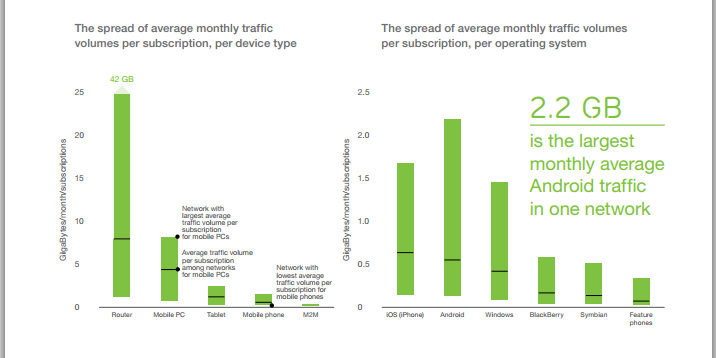
A clear majority of mobile Internet access occurs indoors. In many countries, as much as 80 percent of total mobile device Internet access occurs indoors.


The other driver of traffic is cities, where most people live and work.


Email ThisBlogThis!Share to XShare to Facebook
Posted in | No comments
Newer Post Older Post Home

0 comments:

Post a Comment

Subscribe to: Post Comments (Atom)

Popular Posts

  • Seattle's Gigabit Squared Fails: Sustainability Remains an Issue for Muni Access Networks
    Seattle's Gigabit Squared  network appears to have failed, illustrating a recurring problem with all municipal or joint venture Internet...
  • Access Networks Increasingly are All About Video
    In North America, r eal-time entertainment is responsible for over  68 percent of downstream bytes during peak periods, compared to 65 perce...
  • Using a Drone-Mounted Camera to See what a Surfer Sees "In the Water"
    If you've ever seen a picture of a surfer (the ocean kind), shot from shore, you have one view of what's going on, but you can't...
  • New Report Confirms: Investment or Competition is a Real Issue for Access Networks
    The latest Ofcom report on U.K. broadband infrastructure illustrates the inherent tension between promoting investment in next generation ne...
  • Google Fiber in Provo Prices Same as Kansas City
    Google Fiber  in Provo, Utah will be priced the same way as Google Fiber in Kansas City. People will be able to sign up for free 5 Mbps down...
  • EC to Review Telefonica, E-Plus Merger: How Many Carriers are Needed in Germany?
    European Union antitrust regulators will examine deals such as the proposal by Telefonica and Royal KPN to combine their German assets, base...
  • AT&T Tower Sale Raises, Does Not Answer, Question of "Core Competency"
    What is AT&T’s “core competency?” That is a question observers might raise, in the wake of AT&T’s decision to sell its U.S. mobile t...
  • How Big a Phone Will You Carry All the Time?
    How big a device will you carry with you, all the time, like you carry a mobile phone? Samsung Mega is going to provide some real-world tes...
  • To Attack U.S. Mobile Pricing Structure, Sprint and T-Mobile US Will Have to AddressTheir Own Cost Structures
    If a mobile service provider wants to attack prevailing retail prices in a serious way, it also has to attack its own operating and possibly...
  • Market Disruption is a Game Verizon Can Play as Well
    One often tends to think that big market disruptions are caused by small, upstart firms. History might suggest something quite different. Y...

Blog Archive

  • ►  2014 (23)
    • ►  January (23)
  • ▼  2013 (476)
    • ►  December (83)
    • ▼  November (79)
      • Big Telecom Merger Wave Coming, Between 2014 and 2...
      • Telecom Malaysia Revenue Grows, Fixed Broadband Helps
      • U.K. Looks for 650 MHz More Wi-Fi and Mobile Spectrum
      • Above-Average Economic Growth in "Developing" Regi...
      • How Widely Could Small Cells Substitute for Fiber ...
      • NAB, DoD Agreement Clears Way for Auction of 50 MH...
      • Fixed Network Revenue Already Walks on Two Legs: W...
      • Tablets Top Long Forrm Viewing on Connected Devices
      • Global Telecom Revenue Will Grow 2.7% Annually, Th...
      • Carrier Voice and Messaging: Should Service Provid...
      • How Long Until "Peak Text Messaging Revenue?"
      • Wi-Fi is Primary Way to Connect to Internet in 16 ...
      • Maybe OTT Messaging Hasn't Visibily Cannibalized M...
      • Does Bundling Still Work?
      • Verizon "Spot Deploys" Fiber to Home to Drive Main...
      • Smart Phone Shipments Will Be 82% of All Handset S...
      • How Will Service Providers Find Investment Capital...
      • What is the Economic Contribution of "Free" Servic...
      • Will Most ISPs Eventually Offer Free 5 Mbps Service?
      • Video Mergers Might Challenge FCC Horizontal Conce...
      • Africa Broadband Adoption Low, but Poised for Big ...
      • Will FCC Formally Modify its Historic Cable TV Ind...
      • APT 700 Creates World Band for LTE
      • LTE in Unlicensed Spectrum?
      • "Europe Falling Behind" is Temporary, as was "U.S....
      • Google Builds First "Middle Mile" Network
      • Is Privacy an Anomaly on Social Networks?
      • Will 90% of Mobile Traffic Be Terminated on Wi-Fi?
      • Czech 4G Auction Fails to Bring New Competition
      • Will Amazon Web Services Be Worth $76 Billion in 2...
      • Mobile-Accessed Sites More Important in Some Indus...
      • Stockholm, London, Singapore are Global "Most Conn...
      • At Some Point, Legacy Networks are Too Expensive t...
      • TV White Spaces Business Model an Issue for CIO Group
      • Apple Average Selling Price More than Double the A...
      • FCC and CTIA Largely In Agreement About Device Unl...
      • Cloud Computing Business Worth $188 Billion by 2022?
      • No Surprise: Owners of Internet-Connected TVs Like...
      • Nobody Makes Profits Selling Smart Phones, Save Ap...
      • B2B Brand Messaging Misfires With Buyers, McKinsey...
      • European Mobile Network Investment Has Fallen 67%
      • Sprint Needs Lower Frequeny Spectrum More than a M...
      • Amazon Web Services Bigger than All the Rest of Am...
      • SoftBank, Bell Mobility Join Global M2M Association
      • "No Killer App" is a Key Service Provider Challeng...
      • Will Fourth Wave Telco Services Be Big Enough to O...
      • U.S. Telcos Have Lost 62% of Voice Lines
      • T-Mobile US to Sell $2 Billion in New Shares to Bu...
      • Will Fixed Network Revenues Grow as Mobile Revenue...
      • Is European Mobile Revenue Slide Near a Turning Po...
      • Apple TV: Content, Sales Volume, Uniqueness are Ke...
      • Some Prepaid Service Providers Face Cost Reduction...
      • Mobile Data Demand will Grow an order of Magnitude...
      • Without Small Cells, Video Conferencing and Stream...
      • Larger, Curved, More Sensitive Screens for iPhone?
      • Mobile Broadband Grows Between 27% and 82% Annually
      • Fixed Network Broadband Costs Have Fallen At Least...
      • Own the Desktop, Living Room, Platform or Experience?
      • Telenor Users to Get Free Wikipedia Access in Myanmar
      • Google South Africa TV White Spaces Trial Ends, No...
      • Device Preferences Shape Service Provider Opportun...
      • Inhabitants Per Household Drives Bandwidth Demand,...
      • LTE Capex Shifts to Software
      • Gigabit Connections Will Be Commonplace by 2020, R...
      • Los Angeles Wants Bidders for a New Fiber to Home ...
      • C Spire, the Mobile Company, to Build Fixed Gigabi...
      • EE Launches Beta of LTE-Advanced, Supporting 300 Mbps
      • Spanish Firm Building Private Wi-Fi Offload Networ...
      • A Business Model for Licensed Wi-Fi Spectrum? Glob...
      • Time Warner Cable in Play?
      • Android Surges to 81%b Global Market Share, and Th...
      • OECD Mobile Broadband Users Paying 4% Less for Spe...
      • AT&T to Deploy 40,000 Small Cells as Part of Move ...
      • BlackBerry Cancels Sale Process, Will Remain Indep...
      • 0.07 Percent of Startups Reach $1 Billion Valuations?
      • Tech Sector Is In A Bubble
      • Is the U.S. Ahead, Behind or at Par, in Terms of B...
      • Why is Time Warner Cable Losing Customers?
      • Patent War Erupts Again: Time to Stop It
    • ►  October (127)
    • ►  September (95)
    • ►  August (92)
Powered by Blogger.

About Me

Unknown
View my complete profile