Broad Soft

  • Subscribe to our RSS feed.
  • Twitter
  • StumbleUpon
  • Reddit
  • Facebook
  • Digg

Wednesday, 8 January 2014

How Big a Revenue Stream Will Connected Cars Generate for Mobile Service Providers?

Posted on 10:14 by Unknown
There’s an obvious reason why the “Internet of Things” and “machine-to-machine” services get so much attention from mobile service providers: once the industry has sold at least one mobile phone connection to just about every person, “line growth” has to shift to other “connectable devices,” especially those performing best with a full-time, dedicated connection.

Tablets, personal hotspots and game players are among the logical candidates for additional connections after the phone.

But vehicles are interesting for any number of reasons. For starters, vehicles always have been important media consumption platforms (radio, satellite radio). But with navigation and vehicle diagnostics assuming higher profiles, there are additional reasons for people to want Internet communications and content in their vehicles: cars are an excellent platform for mobile Internet and apps.

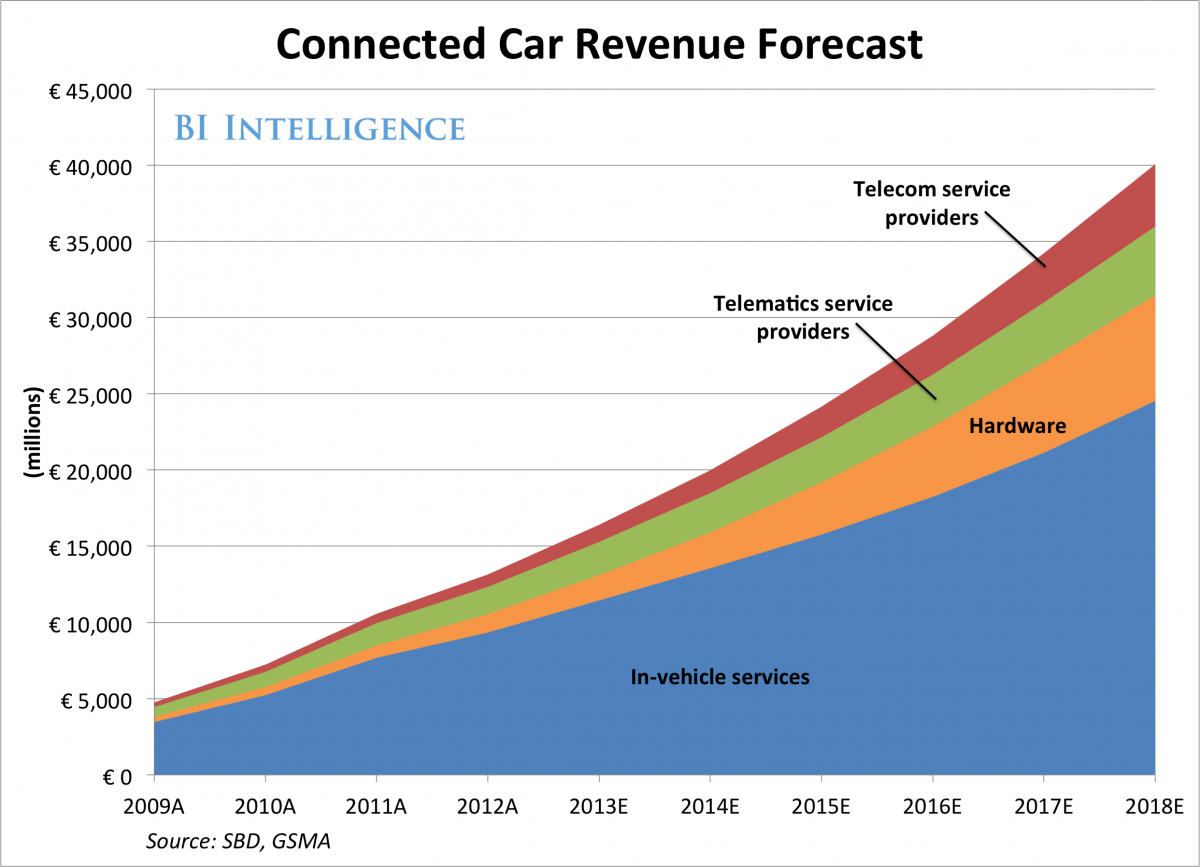
By some estimates, by about 2018 there could be 60 million connected cars globally using connected car services. In a mobile communications business with billions of users, that might not sound like much.

But those connected vehicles might create a new business collectively representing perhaps $51 billion in annual revenue.

Research firm SBD estimates the overall connected car market will be three times larger in 2018 than it was in 2012.

About 61 percent of projected 2018 global revenue will be generated from in-vehicle services, such as traffic information, call center support and web-based entertainment. In other words, apps and services will generate the majority of global revenue.

Hardware will generate about 17 percent of global revenue. Some 11 percent will be earned by providers of telematics services, such as customer relationship management, SBD predicts.

Connectivity will represent about 10 percent of total global connected car revenue of $40 billion to $50 billion.

Vehicle Internet connections alone then might be $4 billion to $5 billion by 2018. And the unknowable question is how much other revenue mobile service providers might be able to generate if they participate as equity owners in the apps and services that actually will generate most of the revenue.

The other angle is that in some instances, the mobile handset will be docked to the vehicle, becoming the access and application processor. That means there is potential indirect revenue to be earned, as well as account stickiness features, if the user finds the mobile handset also powers in-vehicle apps and communications, even when an additional “line” is not sold.

Such tethering is in many ways the faster way to gain market share (either for the vehicle manufacturer or access provider), since many of the details of negotiating operating agreements and adding new vehicle electronics are minimized.

Embedding offers integration advantages, but costs more, and will take time.

Email ThisBlogThis!Share to XShare to Facebook
Posted in | No comments
Newer Post Older Post Home

0 comments:

Post a Comment

Subscribe to: Post Comments (Atom)

Popular Posts

  • Seattle's Gigabit Squared Fails: Sustainability Remains an Issue for Muni Access Networks
    Seattle's Gigabit Squared  network appears to have failed, illustrating a recurring problem with all municipal or joint venture Internet...
  • To Attack U.S. Mobile Pricing Structure, Sprint and T-Mobile US Will Have to AddressTheir Own Cost Structures
    If a mobile service provider wants to attack prevailing retail prices in a serious way, it also has to attack its own operating and possibly...
  • New Report Confirms: Investment or Competition is a Real Issue for Access Networks
    The latest Ofcom report on U.K. broadband infrastructure illustrates the inherent tension between promoting investment in next generation ne...
  • AT&T Tower Sale Raises, Does Not Answer, Question of "Core Competency"
    What is AT&T’s “core competency?” That is a question observers might raise, in the wake of AT&T’s decision to sell its U.S. mobile t...
  • How Big a Phone Will You Carry All the Time?
    How big a device will you carry with you, all the time, like you carry a mobile phone? Samsung Mega is going to provide some real-world tes...
  • Access Networks Increasingly are All About Video
    In North America, r eal-time entertainment is responsible for over  68 percent of downstream bytes during peak periods, compared to 65 perce...
  • Google Fiber in Provo Prices Same as Kansas City
    Google Fiber  in Provo, Utah will be priced the same way as Google Fiber in Kansas City. People will be able to sign up for free 5 Mbps down...
  • AT&T Delays Special Access Rate Changes
    Shutting down the public switched network, specifically the time division multiplex network, remains a contentious issue, even though everyb...
  • Cheaper to Manufacture in U.S. Than China, Firms Find
    One of the biggest problems people and forecasters make is to extrapolate from current trends into the future.  But trends change. Consider ...
  • U.S. Mobile Market Disruption Will Not be Easy
    Based on SoftBank's ability to shake up the Japanese mobile market, many observers expect a similar assault in the U.S. market, from a S...

Blog Archive

  • ▼  2014 (23)
    • ▼  January (23)
      • Seattle's Gigabit Squared Fails: Sustainability Re...
      • How Big a Revenue Stream Will Connected Cars Gener...
      • Mobile Penetration No Less than 72%, Anywhere
      • Sprint Redefines "Family" Plan with New "Framily" ...
      • Global Device Shipments Up 7.6% in 2014
      • Sony to Launch Streaming TV Service in U.S. in 2014
      • Verizon and AT&T Have Captured Most of the U.S. Mo...
      • Europe has Lowest LTE Retail Prices: Good for Cons...
      • AT&T Introduces "Toll Free" Data Service for Partners
      • Winners and Losers in Content
      • Some Pro-Competitive Policies Just Don't Work
      • Verizon Wireless, T-Mobile US Want to Swap Spectrum
      • Google Launches Connected Car Initiative
      • Will End of Smartphone Subsidies Actually Help Mob...
      • Small Merchant Adoption of Mobile Credit Card Read...
      • Mobile Now More than 65% of All U.S. Internet Acce...
      • How Big a Business Can "Exposing Network Services"...
      • WhatsApp Takes OTT Messaging Lead
      • "Micro-Basic" Subscription Video Tiers in 2014?
      • One More Example of How Internet Apps Can Grow ISP...
      • How Much Text Messaging Cannibalization, Really?
      • FAA Authorizes Commercial-Drone Testing
      • Economics Does Not Explain Everything Because "Irr...
  • ►  2013 (476)
    • ►  December (83)
    • ►  November (79)
    • ►  October (127)
    • ►  September (95)
    • ►  August (92)
Powered by Blogger.

About Me

Unknown
View my complete profile