Broad Soft

  • Subscribe to our RSS feed.
  • Twitter
  • StumbleUpon
  • Reddit
  • Facebook
  • Digg

Monday, 9 December 2013

Carriers Pursue Different 4G Business Models

Posted on 08:45 by Unknown

There are several different revenue models driving fourth generation Long Term Evolution spectrum decisions.

For some carriers, the issue is simply a need for additional capacity.

Though carriers expect and hope that some incremental revenue can be generated, the strategic issue simply is that more spectrum is required, with or without the expectation of immediate net revenue growth from "new services."

The ability to support current customers and demand is reason enough to add more capacity.

In a few cases, 4G has additionally had at least a temporary perceived advantage. Sprint thought its embrace of WiMAX was that sort of decision, allowing it to move first and uniquely in the 4G services market.

In the United Kingdom, EE was able to launch 4G in former 3G spectrum, before the holding of 4G auctions or the building of the new networks.

For some attacking carriers, 4G is a weapon to continue a price assault, as Free Mobile is doing.

Longer term, some carriers also think 4G could enable unicast video services.

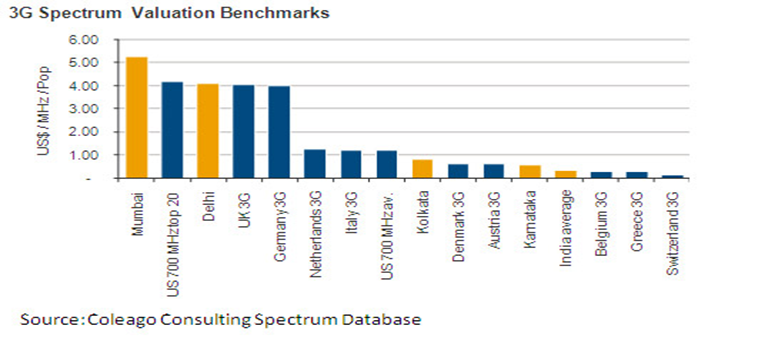
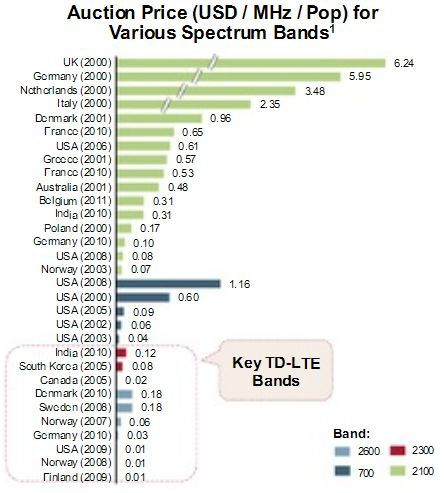
Still, contestants sometimes have paid too much to acquire assets. That was true of some Western European operators who, in retrospect, paid too much for 3G spectrum.

Service providers have become wary of such excesses, and auctions for fourth generation Long Term Evolution spectrum, while high in some cases, have not reached levels seen in a few 3G auctions.

But even “rational” decisions can be uncertain, in highly competitive markets.

In the case of a few 3G auctions, one might argue the problem was not the high cost of spectrum, but the low amount of new revenue, and the delay in “discovering” important new apps, which wound up being mobile email, and then mobile Internet access and then personal Wi-Fi hotspots.

In that regard, the danger with LTE auction prices is not so much the absolute cost of new spectrum, which is in some ways a necessary precondition for remaining in business in the future.

The danger is that that increased outlays for spectrum are not fully offset by new revenue streams, or at least higher revenue streams, even if important new apps do not appear immediately.

In markets where customers assume their is a price premium for getting access to LTE’s faster speeds and lower latency, the revenue model is clear. The bigger problem is markets where LTE investments are made, but there is no pricing premium.

That isn’t to say there is no value. Faster speeds and lower latency might well discourage customer churn. But if all major competitors in a market can offer LTE, then the value as a marketing platform is reduced.

Faster networks have value, to be sure. But it is hard to measure the competitive value if all service providers also offer faster speeds.

In the past, supporters of LTE have argued that the real immediate value is the greater bandwidth efficiency of 4G, compared to 3G, used to support data bandwidth. Nor is there doubt that ownership of more spectrum, in markets where demand for data access is growing, has value.

But is has to be disconcerting that LTE access carries no price premium at all, for at least some providers.

French mobile service provider Free Mobile has added an LTE 4G high-speed broadband service to its Free Mobile package without raising the price, in a market where its chief rivals charge a premium for using the 4G network.

Iliad says its monthly Free Mobile subscription remains unchanged at 19.99 euros a month including 4G, without a long-term contract. The no incremental charge policy has a clear logic, of course.

Illiad expects it can use its pricing advantage to further attack the bigger carriers, taking market share. So in the case of Free Mobile, the revenue model is “new subscribers,” not incremental revenue from offering customers a faster network.

Recently, mobile operators in India have faced the problem of revenues insufficient to allow recovery of investments, as well, unrelated to the particular problem of spectrum costs.

India's Bharti Airtel, for example, bought Zain's African operations in 2010 for $10.7 billion, considered a high price at the time, to gain access to the high growth potential in Africa. But competition has lead to low retail prices.

Bharti's average revenue per user grew eight percent from 2012 levels to 192 rupees in India and fell 10 percent in Africa.

For the moment, though, the big incremental decisions turn on spectrum investments.

Since no company invests capital without anticipating a return, every buyer of LTE spectrum has an explicit revenue model. In some cases, there also is an operating cost model (LTE offers lower cost per bit).

But what one hopes is not the case that investments in LTE, or investments in fiber to the home, are not ulimately a matter of “you get to keep your business.” In other words, as many fiber to home investments have largely been made to trade market share with a key competitor, it is not always the case that a traditional return on investment thesis drives the decision.

Instead, the investments are defensive in nature, more a strategic investment than a traditional “high return on investment” decision.


Email ThisBlogThis!Share to XShare to Facebook
Posted in | No comments
Newer Post Older Post Home

0 comments:

Post a Comment

Subscribe to: Post Comments (Atom)

Popular Posts

  • Seattle's Gigabit Squared Fails: Sustainability Remains an Issue for Muni Access Networks
    Seattle's Gigabit Squared  network appears to have failed, illustrating a recurring problem with all municipal or joint venture Internet...
  • Access Networks Increasingly are All About Video
    In North America, r eal-time entertainment is responsible for over  68 percent of downstream bytes during peak periods, compared to 65 perce...
  • Using a Drone-Mounted Camera to See what a Surfer Sees "In the Water"
    If you've ever seen a picture of a surfer (the ocean kind), shot from shore, you have one view of what's going on, but you can't...
  • New Report Confirms: Investment or Competition is a Real Issue for Access Networks
    The latest Ofcom report on U.K. broadband infrastructure illustrates the inherent tension between promoting investment in next generation ne...
  • Google Fiber in Provo Prices Same as Kansas City
    Google Fiber  in Provo, Utah will be priced the same way as Google Fiber in Kansas City. People will be able to sign up for free 5 Mbps down...
  • EC to Review Telefonica, E-Plus Merger: How Many Carriers are Needed in Germany?
    European Union antitrust regulators will examine deals such as the proposal by Telefonica and Royal KPN to combine their German assets, base...
  • AT&T Tower Sale Raises, Does Not Answer, Question of "Core Competency"
    What is AT&T’s “core competency?” That is a question observers might raise, in the wake of AT&T’s decision to sell its U.S. mobile t...
  • How Big a Phone Will You Carry All the Time?
    How big a device will you carry with you, all the time, like you carry a mobile phone? Samsung Mega is going to provide some real-world tes...
  • To Attack U.S. Mobile Pricing Structure, Sprint and T-Mobile US Will Have to AddressTheir Own Cost Structures
    If a mobile service provider wants to attack prevailing retail prices in a serious way, it also has to attack its own operating and possibly...
  • Market Disruption is a Game Verizon Can Play as Well
    One often tends to think that big market disruptions are caused by small, upstart firms. History might suggest something quite different. Y...

Blog Archive

  • ►  2014 (23)
    • ►  January (23)
  • ▼  2013 (476)
    • ▼  December (83)
      • New Sprint Nextel Business Offer Might Combine Fix...
      • How Much has the Internet Harmed the Telecom Busin...
      • What Device Sales Indicate About Next Era of Compu...
      • 10 things not to buy in 2014
      • Net Neutrality is Part of an Older Pattern of Tech...
      • Which Revenue Opportunity is Bigger for Mobile Ser...
      • "Near Zero Pricing" for Voice is Not the Problem i...
      • SoftBank Bid for T-Mobile US Could Reshape Thinkin...
      • Are Fixed, Satellite, Cable TV, Mobile Distinct Ma...
      • What's Upside for AT&T Gigabit Networks?
      • Some Things Won't Change in 2014
      • Cheaper to Manufacture in U.S. Than China, Firms Find
      • Will T-Mobile US (and someday Sprint) Achieve Ilia...
      • Internet Does Not Change the Fact that Most Commun...
      • Where Fixed Broadband Prices in Developing Nations...
      • 2013 Not the Year Video Subscription Business Breaks
      • The Year Broadband Access Prices Were "Destroyed"
      • Raising $20 Billion is the Easy Part of Potential ...
      • Freemium is Leading App Pricing Model
      • Rise of Ad-Supported App Firms Could Have Access P...
      • Can "Internet Access" Be More Than a Commodity?
      • Sprint, Dish Network to Test Fixed Wireless
      • EE Now Supports AT&T Customer 4G Roaming in United...
      • 4 and 3: Why Sprint Purchase of T-Mobile US Faces ...
      • Australia NBN Will Miss Target of 25 Mbps to All b...
      • Spectrum Exhaust? Not Likely
      • If Price Were No Object, Would Most People Buy iPh...
      • Could a Merged Spring-T Mobile US Change 600 MHz A...
      • Is U.S. Mobile Market About to be Rearranged?
      • Study Suggests Amazon Kindle Strategy Works
      • What Drives "UnCarrier" Success?
      • Is Utopia in Utah a Potential Investment Target fo...
      • How Important is Ownership of Mobile Access Assets?
      • The New Demand for Asymmetrical Networks
      • One Way Google Fiber Has Changed Regulator Thinking
      • Installment Plans are Similar to "Device Subsidies...
      • The Song that Eventually was Released by the Rolli...
      • Is A La Carte TV a "Farce?"
      • U.K. Consumers Pay Less for Communications, Ofcom ...
      • First Passive Infrastructure Sharing; Then Active ...
      • AT&T Essentially Will Pay its Austin Access Custom...
      • Sustainability a Key Issue for Public-Private Fibe...
      • We Forget that Transition to Optical Fiber Once Wa...
      • Why Economics Matters for the Supply of Broadband ...
      • The Fixed Network Business Case: An Illustration
      • Carriers Pursue Different 4G Business Models
      • Verizon Acquires Content-Delivery Firm EdgeCast Ne...
      • To Attack U.S. Mobile Pricing Structure, Sprint an...
      • Motorola Modular Phone Prototype "Almost Ready"
      • Usage-Based Billing Might be Good for Many Enterpr...
      • U.S. Smart Phone Penetration Reaches 63%
      • Enterprise Customers Say More Cloud, More Consolid...
      • Does the Telecom Industry have a Life Cycle?
      • Indian Mobile Market Illustrates Key Principle Abo...
      • Why Sprint is Certain to Launch a Price War
      • A Scary Bit of History
      • Video Traffic is Moving from "North-South" to "Eas...
      • Rare Earth Elements Underpin Modern Electronics, a...
      • U.S. Auction of Broadcast TV Spectrum by Mid-2015?
      • Another Cycle of Faulty Predictions and Forecasts ...
      • Regulators in Mexico, Brazil Act to Spur Competiti...
      • Two Views on Bitcoin
      • Mobile Broadband will be 81% of Total Broadband in...
      • M2M Might Represent 6% of Global Mobile Connection...
      • Chinese iPhone Buyers are Not "Average"
      • VoLTE Will Help Mobile Service Providers Shut Down...
      • New FCC Chairman Distinguishes Between "No Blockin...
      • Windstream Isn't the Company It Used to Be
      • More Trouble for 4G LTE Investment Models
      • Half of all Smart Phones Bendable by 2019?
      • Why Word of Mouth is Essential for Really Big Comp...
      • Will Change to Communications Act of 1996 Create N...
      • It's not Easy to Run a Carrier-Owned Over the Top ...
      • BlackBerry Says It Isn't Dead
      • Amazon Prime Air Will Need Approval from Federal A...
      • Most Additional Mobile Spectrum Has to Come from E...
      • Up to This Point, "New Services Revenue" Has Come ...
      • Cable, Telco, ISPs Generally Score Very Low on Cus...
      • Oddly Enough, it is Nearly Inpossible to Tell Whet...
      • Android, Windows Phone Shipments Grow Based on Price
      • Twitter More Popular than Facebook Among Users 15 ...
      • 24% of Thanksgiving, Black Friday Shopping Volume ...
      • What is M2M Internet of Things Impact on Mobile Ne...
    • ►  November (79)
    • ►  October (127)
    • ►  September (95)
    • ►  August (92)
Powered by Blogger.

About Me

Unknown
View my complete profile