Broad Soft

  • Subscribe to our RSS feed.
  • Twitter
  • StumbleUpon
  • Reddit
  • Facebook
  • Digg

Friday, 27 September 2013

If You Use the Internet, You Have Access at Home, Surveys Suggest

Posted on 04:31 by Unknown
Just about every U.S. adult that uses the Internet has access to the Internet at home, using fixed network access, mobile access or both, new studies suggest. That suggests that account growth now is dependent largely on new home construction, continued use of the Internet when new households are formed, and a slight shift of dial-up to broadband.


Some 78 percent of U.S. households buy a fixed network broadband access service at home, and broadband now accounts for 94 percent of all Internet access services sold to consumers at home, according to Leichtman Research Group.


In 2004 about 33 percent of U.S. households buying Internet access service were buying broadband rather than dial-up service. That figure grew to 75 percent in 2008 and 92 percent in 2012.


In total, 83 percent of U.S. households buy a fixed network  Internet service for use at home, while 55 percent of adults also buy access to the Internet on a smart phone.


The number of U.S. adults using their smart phones to get access to the Internet has grown 44 percent from 2012 levels.

If about 15 percent of U.S. adults choose not to use the Internet, it is likely that most households using the Internet already are buying service, whether fixed, mobile or both, since 83 percent are buying a fixed access service.


Complicating the broadband adoption picture is growing use of mobile Internet access. Some
64 percent of fixed network broadband subscribers also access the Internet on a smart phone, up from 52 percent last year.


In fact, LRG estimates that 19 percent of homes that do not buy at-home fixed network broadband access use smart phones for Internet access, up from 12 percent in 2012.


The study also suggests that “broadband access cord cutting” is nearly non-existent. About one percent of households paid to subscribe to Internet service at home in the past year, do not currently subscribe, and do not plan to subscribe again in the next six months, LRG says.


Nor is availability of fixed network Internet access much of a problem. Less than one percent of all online households say that broadband is not available in their area. In 2008 that percentage was six percent.


In other words, if people do not buy Internet access at home these days, it mostly is because they do not use the Internet and therefore have no need for an access service.


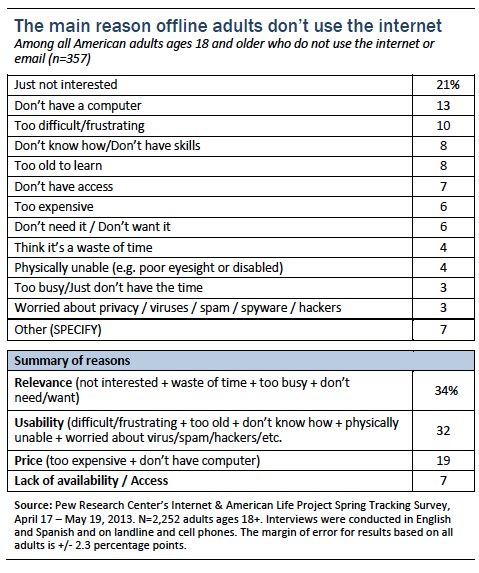
The LRG findings corroborate a study by the Pew Internet and American Life Project suggesting
that about 15 percent of U.S. adults ages 18 and older do not use the Internet.


Of the non-users, about 34 percent reported that the “Internet is just not relevant to them,” meaning they are not interested, do not want to use it, or claim to have no need for it.


Some 32 percent of non-Internet users claim they do not use the Internet because it is not very easy to use. Such non-users say the Internet is difficult or frustrating to use, or they are physically unable to do so.


In other cases, non-users say they are worried about other security-related issues such as spam, spyware, and hackers.


About 19 percent of non-internet users cite the expense of owning a computer or paying for an internet connection.


In about seven percent of cases, non-users said there was a physical lack of availability issue or some other reason they could not get access to the Internet, the Pew Internet and American Life Project says.


Perhaps the moset surprising finding is that 44 percent of U.S. residents ages 65 and older do not use the Internet. In fact, such older people represent 49 percent of non-Internet users overall.


Earlier Pew  studies had found in 2012 that Internet use among older users was about 53 percent, so the 2013 findings are consistent.


According to Gallup, just about 17 percent of people 65 or older use the Internet every day.


Studies from the United Kingdom likewise have shown a usage gap, where about 30 percent of people 65 or older report using the Internet. Perhaps 14 percent of U.K. residents have never used the Internet, the The UK’s Office for National Statistics reports.


source: http://www.equalitysouthwest.org.uk/blog/view/internet-access


On the other hand, Internet non-users often are “using” the Internet indirectly. Though they themselves do not go online, self-described non-internet users often do so indirectly.
About 44 percent of reported offline adults have asked a friend or family member to look something up or complete a task on the internet for them, for example.
Email ThisBlogThis!Share to XShare to Facebook
Posted in | No comments
Newer Post Older Post Home

0 comments:

Post a Comment

Subscribe to: Post Comments (Atom)

Popular Posts

  • Seattle's Gigabit Squared Fails: Sustainability Remains an Issue for Muni Access Networks
    Seattle's Gigabit Squared  network appears to have failed, illustrating a recurring problem with all municipal or joint venture Internet...
  • Can "Internet Access" Be More Than a Commodity?
    What makes today’s “Internet access” different from voice, text messaging or video entertainment? The answer explains why service providers ...
  • Debate over "Fiber to Home" Versus "Fiber to Node" Erupts Again in Australia
    Oddly enough, for some of us, a debate over access network architecture, specifically fiber to the home or fiber to the node, appears to be ...
  • Apple TV: Content, Sales Volume, Uniqueness are Key Challenges
    Some observers argue Apple needs to launch a TV device (a display) to spur growth. Others might argue that is a mistake.  Some might argue ...
  • How 1 Philippines Telco Monetizes Over the Top Messaging
    Mobile service providers globally face big problems in the messaging space, as users are showing high preference for no incremental cost ove...
  • Mobile Now More than 65% of All U.S. Internet Access Connections
    Of 262 million U.S. broadband access connections, there were almost 65 million fixed and 64 million mobile connections with download speeds ...
  • Will End of Smartphone Subsidies Actually Help Mobile Service Providers and Ecosystem?
    It might seem self evident that smartphone subsidies are a burden for mobile service providers. If that is the case, getting rid of device s...
  • Movie Revenue Model is Breaking
    Sometimes the decline of a business model is historically inevitable even before the peak of revenues for the model. Voice revenues for the ...
  • Access Networks Increasingly are All About Video
    In North America, r eal-time entertainment is responsible for over  68 percent of downstream bytes during peak periods, compared to 65 perce...
  • Verizon Acquires Content-Delivery Firm EdgeCast Networks
    In one sense, the  Verizon acquisition of EdgeCast Networks  is a simple way of gaining revenue and customer base in complementary businesse...

Blog Archive

  • ►  2014 (23)
    • ►  January (23)
  • ▼  2013 (476)
    • ►  December (83)
    • ►  November (79)
    • ►  October (127)
    • ▼  September (95)
      • A New Era of Computing and Communications: A Decad...
      • Video Makes "Pricing by Value" Difficult
      • Provo, Utah Residents Get Google Fiber 1-Gbps Serv...
      • Exposing Network Features to Create Revenue is Har...
      • Competing with "Free" Remains an Issue
      • Does Wireless Charging Cause RF Interference?
      • Competing with "Free" Remains an Issue
      • Intel TV Seeking Partners?
      • 89% of U.K. Fixed Connections are "Untethered"
      • Revenue Sluggishness Will Propel Consolidation Wave
      • U.S. 4G Users Consume 36% More Data
      • If You Use the Internet, You Have Access at Home, ...
      • Google's 1998 Look
      • Access Networks Increasingly are All About Video
      • Nearly 70 million U.S households will have Smart T...
      • 4G Nets Will Carry 66% of All Mobile Traffic by 2018
      • Fourth Revenue Wave Will be the Toughest
      • What Drives Mobile Revenue Growth After M2M or Int...
      • Percentage of Portential Video Cord Cutters Less I...
      • AT&T "Open" to European Acquisitions
      • T-Mobile CFO Says Merger with Sprint Could Happen
      • AT&T Believes Economics of Gigabit Access Networks...
      • AT&T Wants to Create Multicast Video Delivery Service
      • 60% of U.S. Mobile Phone Users Access Internet fro...
      • Fixed Broadband Prices Have Dropped 82% Over 5 Years
      • Telefonica to Own Most of Telecom Italia
      • AT&T, Fon Sign Roaming Deal
      • Australia NBN Making Course Correction to Save $56...
      • Rights to Supply TV Series to Support "Binge Viewi...
      • Will Telco Video Services Go Nationwide, as Mobile...
      • How is Home Automation, Security Business Differen...
      • What Declining Product Demand Looks Like at Colleg...
      • Microsoft Will Buy Your Old Tablets and Smartphones
      • "Mobile Mostly" Content Consumption Trend Grows
      • Movie Revenue Model is Breaking
      • Apple Sticks to Strategy: No "Junk"
      • New Opposition to EC "Connected Continent" Plan
      • Smart Phone, Tablet Adoption in Asia is Study in C...
      • What is the Revenue Model for Mobile Apps?
      • Postpaid Wireless Data Revenues Dominate Telecom R...
      • ISPs Drop Gigabit Service Pricing from $300 a Mont...
      • U.S. Mobile Market Disruption Will Not be Easy
      • Multi-Sided Markets are Complex, Therefore Slow to...
      • 66% of All Mobile Phone Users Use Internet on Thei...
      • Google Wallet Can be Used by Any Android Running V...
      • Does Broadband "Cause" Economic Growth and Higher ...
      • In Different Ways, Microsoft and Apple Both Bank o...
      • Revenue Role Reversal for Fixed, Mobile Networks?
      • Over the Top Video Entertainment Suffers Because o...
      • Growing Mobile Internet Access Has Implications fo...
      • Sprint Launches "One Up" Device Upgrade Program
      • Are Apple and Nokia Mirror Images?
      • Expected Europe Consolidation Wave Causes EE to Re...
      • Is Apple Making the Same Mistake, Again?
      • Auction Policies Should Work, Not Just "Sound Good"
      • U.S. to Auction 10 MHz of Mobile Spectrum Now, 55 ...
      • T-Mobile's LTE network now covers 180 million peop...
      • Verizon Wants to Sell FiOS TV Nationwide
      • Kabel Deutschland Shareholders Vote to Sell to Vod...
      • How Big a Deal is the Right to Sell iPhones?
      • How Mobile Payments, Minimum Wage Demands are Corr...
      • An Illustration of How Speed Transforms Internet M...
      • EC to Review Telefonica, E-Plus Merger: How Many C...
      • Tablet Sales to Eclipse PCs by 2015
      • Will "Connected Continent" Plan Spur Infrastructur...
      • European Commission Announces "Connected Continent...
      • European "Single Telecom Market" Proposals Coming ...
      • Vodafone Gets Ready to Grow
      • 44% of Fixed Broadband Homes Buy an OTT Subscripti...
      • How Big Will U.S. Mobile Revenue Be in 2017?
      • Fingerprint Reader is the Significant Takeaway as ...
      • Virgin Media to Feature Netflix
      • Network Neutrality: The Long Term Implications
      • Verizon Headed for Net Neutality Win?
      • Net Neutrality in Court Again
      • Consumer Devices Using Organization Networks will ...
      • Regulators Favoring New Entrants in Spectrum Auctions
      • Amazon Launching a Free Smart Phone? Maybe Not.
      • Hong Kong Mobile Operators Each Could Lose 33% of ...
      • U.S. Mobile Market Share Now Hinges on Organic Gro...
      • DoCoMo Finally Gets the Apple iPhone
      • Microsoft Nokia Buy Puts More Pressure on BlackBerry
      • Majority of Android Handset Traffic Uses Wi-Fi, in...
      • Mobile Accounts Outnumber Fixed Lines More than 6:1
      • Yelp Really Works, Study Finds
      • Can Microsoft Nokia Make a Dent in Apple Samsung H...
      • Study Confirms: Most People Watch One to 10 Channels
      • Largest Price War in U.S. Mobile History is Coming
      • Huge and Risky Bets are Being Placed in Global Mob...
      • Microsoft Steve Ballmer Succession Now Could be Af...
      • Verizon Purchase of Vodafone Verizon Wireless Asse...
      • Microsoft to Buy Nokia's Handset Business
      • Cloud-Based UC is Growing in U.S., Still Lags Glob...
      • Vodafone Agrees to Sell its Stake in Verizon Wirel...
      • Microsoft Research Study Shows People are Rational...
    • ►  August (92)
Powered by Blogger.

About Me

Unknown
View my complete profile