Broad Soft

  • Subscribe to our RSS feed.
  • Twitter
  • StumbleUpon
  • Reddit
  • Facebook
  • Digg

Tuesday, 17 September 2013

Revenue Role Reversal for Fixed, Mobile Networks?

Posted on 06:46 by Unknown
In many ways, mobile service providers might hope Western Europe does not represent the future of the global business. In some ways, fixed network operators might hope Western Europe is a model for the future.

The reason is that fixed network revenue sources seem to be growing, as a percentage of total industry revenues, compared to mobile revenue sources, which seem to be shrinking, as a percentage of total industry revenues.

That doesn’t necessarily mean fixed network revenue is growing; it simply is shrinking more slowly than mobile revenues.

It appears mobile is poised for more serious revenue declines than fixed services. “A key factor is mobile's dependence on legacy non-data services compared with fixed-line or cable,” Analysys Mason says.

Already, about 67 percent of fixed operator revenue (excluding content) in Western Europe came from data in 2012.

In fact, though it will strike many as odd, the Great Recession and continuing economic sluggishness in Europe has produced evidence that European consumers consider their fixed service more essential than their mobile services, something many would assumed would operate in the reverse--with mobile services deemed more important than fixed.

Fixed service revenue seems to have been more stable than mobile revenues. In fact, fixed-line bundles have the best take-up in some of the more economically challenged countries, Analysys Mason notes.

Perhaps the primary reason for that fixed network preference is the value-price relationship, compared to the value-price relationship for mobile Internet access.

Also, with growing availability of Wi-Fi access in public and outside the home areas, it is easier to use “Wi-Fi only” or “Wi-Fi mostly” as the Internet access medium.

Oddly enough, after a long period where global growth was driven by mobile services, there now appears to be an opportunity for at least some new growth in the fixed network space based on providing services to mobile users.

Mobile data traffic increasingly is used at locations where fixed operators can supply most customer needs at lower cost and price. The reason is that most consumed data occurs when people are not “out and about,” but at stationary locations, most commonly the home or office.

Though a decade ago the notion that Wi-Fi hotspot networks could be a substitute for mobile access proved incorrect, some believer there could well be a different business terrain over the next several years.

Potentially, fixed broadband providers could cooperate with public Wi-Fi providers, or use owned assets, to create Wi-Fi access that is a reasonably useful primary Internet access method for some customers.

To counter that threat, mobile operators are adding their own public Wi-Fi networks, in part to offload traffic from the mobile network and in part to provide data services at lower cost.

The important potential new development is the reversal of “growth” prospects for mobile and fixed networks. Or, as some analysts suggest, which segment will decline less.


Mobile Service Provider Revenue Sources
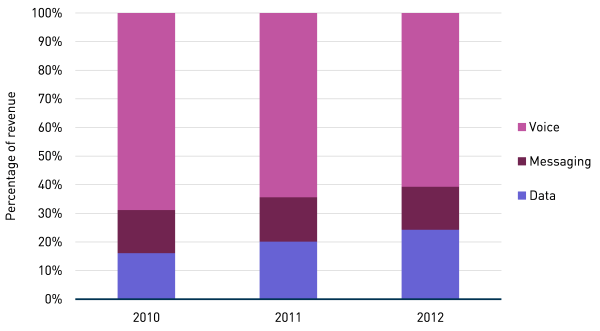


Fixed Network Service Provider Revenues
Perhaps significantly, mobile spending is viewed as more discretionary than fixed network spending, by analysts at Analysys Mason.

Recent results from larger operators in Europe already show faster decline in mobile retail revenue than in fixed, and Analysys Mason forecasts that mobile will represent a declining share of total operator retail telecoms revenue during the next five years.

Spain might provide an example. Though overall service provider revenue is projected to decline over the next two years, fiber-based services on the fixed side and wholesale services or business-to-business mobile services are where revenue growth will be found, according to a new analysis by Pyramid Research.

The Spanish communications market generated €22.6bn ($29.0bn) in 2012, which represented an eight percent decline year-on-year.

Due to the prolonged economic recession, expected to last another two years in Spain, communications market service revenue will return to growth in 2015, up 2.3 percent a year.

Fiber to the home revenues will grow at a compound annual growth rate of 58 percent between 2013 and 2018, reaching $3.3bn in 2018,” says Pyramid Research Senior Analyst, Stela Bokun.   

Mobile revenue growth will come from the enterprise and wholesale segments.

The key takeaway is that revenue growth will be tough, and that growth might be stronger (or declines less sharp) in the fixed network segment of the business.

Email ThisBlogThis!Share to XShare to Facebook
Posted in | No comments
Newer Post Older Post Home

0 comments:

Post a Comment

Subscribe to: Post Comments (Atom)

Popular Posts

  • Seattle's Gigabit Squared Fails: Sustainability Remains an Issue for Muni Access Networks
    Seattle's Gigabit Squared  network appears to have failed, illustrating a recurring problem with all municipal or joint venture Internet...
  • Access Networks Increasingly are All About Video
    In North America, r eal-time entertainment is responsible for over  68 percent of downstream bytes during peak periods, compared to 65 perce...
  • Using a Drone-Mounted Camera to See what a Surfer Sees "In the Water"
    If you've ever seen a picture of a surfer (the ocean kind), shot from shore, you have one view of what's going on, but you can't...
  • New Report Confirms: Investment or Competition is a Real Issue for Access Networks
    The latest Ofcom report on U.K. broadband infrastructure illustrates the inherent tension between promoting investment in next generation ne...
  • Google Fiber in Provo Prices Same as Kansas City
    Google Fiber  in Provo, Utah will be priced the same way as Google Fiber in Kansas City. People will be able to sign up for free 5 Mbps down...
  • EC to Review Telefonica, E-Plus Merger: How Many Carriers are Needed in Germany?
    European Union antitrust regulators will examine deals such as the proposal by Telefonica and Royal KPN to combine their German assets, base...
  • AT&T Tower Sale Raises, Does Not Answer, Question of "Core Competency"
    What is AT&T’s “core competency?” That is a question observers might raise, in the wake of AT&T’s decision to sell its U.S. mobile t...
  • How Big a Phone Will You Carry All the Time?
    How big a device will you carry with you, all the time, like you carry a mobile phone? Samsung Mega is going to provide some real-world tes...
  • To Attack U.S. Mobile Pricing Structure, Sprint and T-Mobile US Will Have to AddressTheir Own Cost Structures
    If a mobile service provider wants to attack prevailing retail prices in a serious way, it also has to attack its own operating and possibly...
  • Market Disruption is a Game Verizon Can Play as Well
    One often tends to think that big market disruptions are caused by small, upstart firms. History might suggest something quite different. Y...

Blog Archive

  • ►  2014 (23)
    • ►  January (23)
  • ▼  2013 (476)
    • ►  December (83)
    • ►  November (79)
    • ►  October (127)
    • ▼  September (95)
      • A New Era of Computing and Communications: A Decad...
      • Video Makes "Pricing by Value" Difficult
      • Provo, Utah Residents Get Google Fiber 1-Gbps Serv...
      • Exposing Network Features to Create Revenue is Har...
      • Competing with "Free" Remains an Issue
      • Does Wireless Charging Cause RF Interference?
      • Competing with "Free" Remains an Issue
      • Intel TV Seeking Partners?
      • 89% of U.K. Fixed Connections are "Untethered"
      • Revenue Sluggishness Will Propel Consolidation Wave
      • U.S. 4G Users Consume 36% More Data
      • If You Use the Internet, You Have Access at Home, ...
      • Google's 1998 Look
      • Access Networks Increasingly are All About Video
      • Nearly 70 million U.S households will have Smart T...
      • 4G Nets Will Carry 66% of All Mobile Traffic by 2018
      • Fourth Revenue Wave Will be the Toughest
      • What Drives Mobile Revenue Growth After M2M or Int...
      • Percentage of Portential Video Cord Cutters Less I...
      • AT&T "Open" to European Acquisitions
      • T-Mobile CFO Says Merger with Sprint Could Happen
      • AT&T Believes Economics of Gigabit Access Networks...
      • AT&T Wants to Create Multicast Video Delivery Service
      • 60% of U.S. Mobile Phone Users Access Internet fro...
      • Fixed Broadband Prices Have Dropped 82% Over 5 Years
      • Telefonica to Own Most of Telecom Italia
      • AT&T, Fon Sign Roaming Deal
      • Australia NBN Making Course Correction to Save $56...
      • Rights to Supply TV Series to Support "Binge Viewi...
      • Will Telco Video Services Go Nationwide, as Mobile...
      • How is Home Automation, Security Business Differen...
      • What Declining Product Demand Looks Like at Colleg...
      • Microsoft Will Buy Your Old Tablets and Smartphones
      • "Mobile Mostly" Content Consumption Trend Grows
      • Movie Revenue Model is Breaking
      • Apple Sticks to Strategy: No "Junk"
      • New Opposition to EC "Connected Continent" Plan
      • Smart Phone, Tablet Adoption in Asia is Study in C...
      • What is the Revenue Model for Mobile Apps?
      • Postpaid Wireless Data Revenues Dominate Telecom R...
      • ISPs Drop Gigabit Service Pricing from $300 a Mont...
      • U.S. Mobile Market Disruption Will Not be Easy
      • Multi-Sided Markets are Complex, Therefore Slow to...
      • 66% of All Mobile Phone Users Use Internet on Thei...
      • Google Wallet Can be Used by Any Android Running V...
      • Does Broadband "Cause" Economic Growth and Higher ...
      • In Different Ways, Microsoft and Apple Both Bank o...
      • Revenue Role Reversal for Fixed, Mobile Networks?
      • Over the Top Video Entertainment Suffers Because o...
      • Growing Mobile Internet Access Has Implications fo...
      • Sprint Launches "One Up" Device Upgrade Program
      • Are Apple and Nokia Mirror Images?
      • Expected Europe Consolidation Wave Causes EE to Re...
      • Is Apple Making the Same Mistake, Again?
      • Auction Policies Should Work, Not Just "Sound Good"
      • U.S. to Auction 10 MHz of Mobile Spectrum Now, 55 ...
      • T-Mobile's LTE network now covers 180 million peop...
      • Verizon Wants to Sell FiOS TV Nationwide
      • Kabel Deutschland Shareholders Vote to Sell to Vod...
      • How Big a Deal is the Right to Sell iPhones?
      • How Mobile Payments, Minimum Wage Demands are Corr...
      • An Illustration of How Speed Transforms Internet M...
      • EC to Review Telefonica, E-Plus Merger: How Many C...
      • Tablet Sales to Eclipse PCs by 2015
      • Will "Connected Continent" Plan Spur Infrastructur...
      • European Commission Announces "Connected Continent...
      • European "Single Telecom Market" Proposals Coming ...
      • Vodafone Gets Ready to Grow
      • 44% of Fixed Broadband Homes Buy an OTT Subscripti...
      • How Big Will U.S. Mobile Revenue Be in 2017?
      • Fingerprint Reader is the Significant Takeaway as ...
      • Virgin Media to Feature Netflix
      • Network Neutrality: The Long Term Implications
      • Verizon Headed for Net Neutality Win?
      • Net Neutrality in Court Again
      • Consumer Devices Using Organization Networks will ...
      • Regulators Favoring New Entrants in Spectrum Auctions
      • Amazon Launching a Free Smart Phone? Maybe Not.
      • Hong Kong Mobile Operators Each Could Lose 33% of ...
      • U.S. Mobile Market Share Now Hinges on Organic Gro...
      • DoCoMo Finally Gets the Apple iPhone
      • Microsoft Nokia Buy Puts More Pressure on BlackBerry
      • Majority of Android Handset Traffic Uses Wi-Fi, in...
      • Mobile Accounts Outnumber Fixed Lines More than 6:1
      • Yelp Really Works, Study Finds
      • Can Microsoft Nokia Make a Dent in Apple Samsung H...
      • Study Confirms: Most People Watch One to 10 Channels
      • Largest Price War in U.S. Mobile History is Coming
      • Huge and Risky Bets are Being Placed in Global Mob...
      • Microsoft Steve Ballmer Succession Now Could be Af...
      • Verizon Purchase of Vodafone Verizon Wireless Asse...
      • Microsoft to Buy Nokia's Handset Business
      • Cloud-Based UC is Growing in U.S., Still Lags Glob...
      • Vodafone Agrees to Sell its Stake in Verizon Wirel...
      • Microsoft Research Study Shows People are Rational...
    • ►  August (92)
Powered by Blogger.

About Me

Unknown
View my complete profile