Broad Soft

  • Subscribe to our RSS feed.
  • Twitter
  • StumbleUpon
  • Reddit
  • Facebook
  • Digg

Friday, 4 October 2013

Consumers, Providers Profoundly Disagree about What A La Carte Video Might Cost

Posted on 13:23 by Unknown
There is a huge disconnect between consumer and content owner or service provider expectations about what a TV channel should cost, if it were possible to buy channels one by one. Consumers think they will save money; distributors and content owners are just as certain they would not save money.


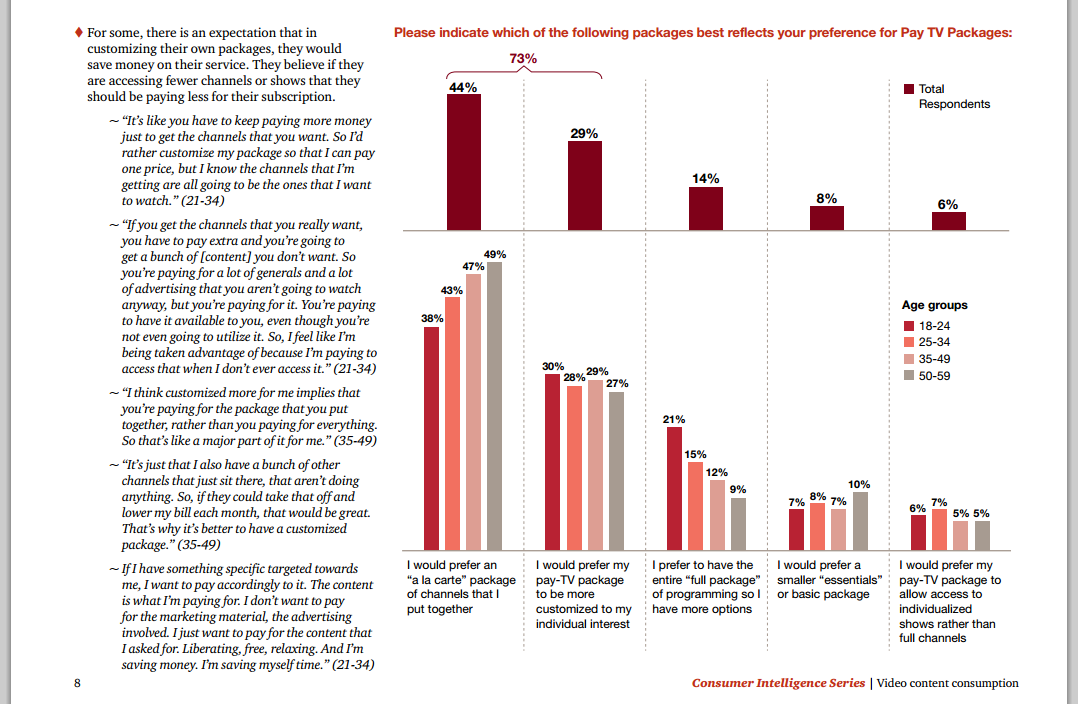
A study by PricewaterhouseCoopers indicates that 44 percent of consumers would like a the ability to buy all their channels one at a time.


Including the 29 percent of respondents that would prefer at least more customization of packages than is currently offered, some 73 percent of consumers surveyed would prefer either the full a la carte purchase option or at least some ability to customize.


Only 14 percent of respondents appear to be satisfied with the current method of packaging.


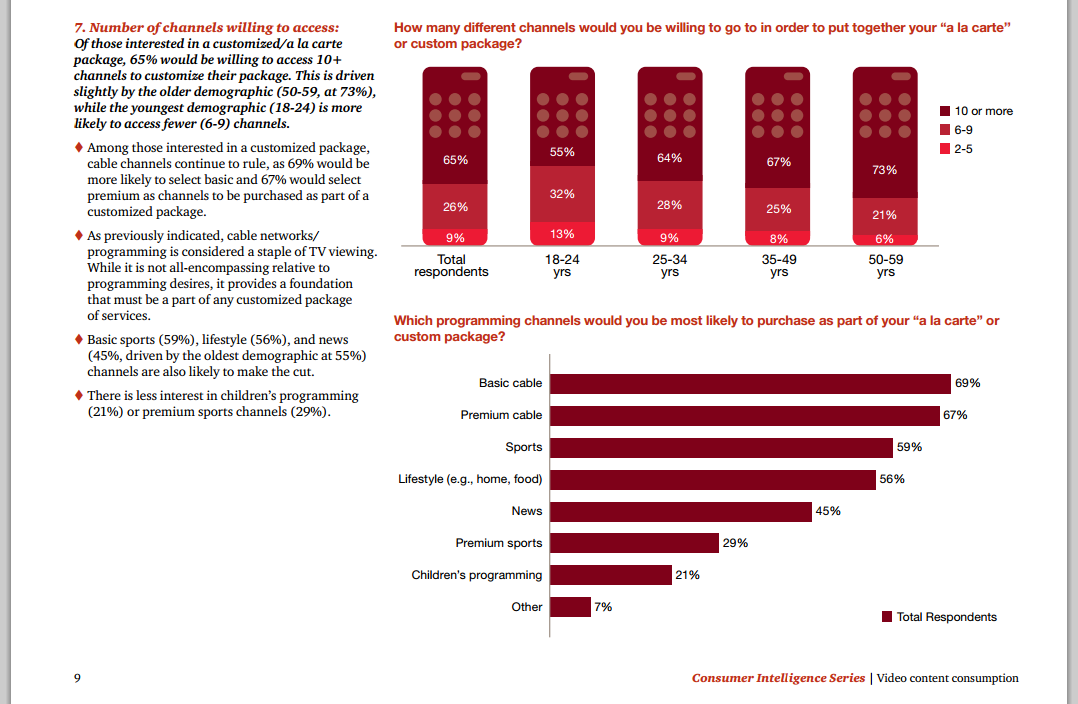
Of those interested in a customized or a la carte package, 65 percent would be willing to access 10 or more channels in a customized package. Older users (50-59) are more likely to want to buy 10 or more channels, while 55 percent of those 18 to 24 are more likely to prefer a package of 10 or more channels.

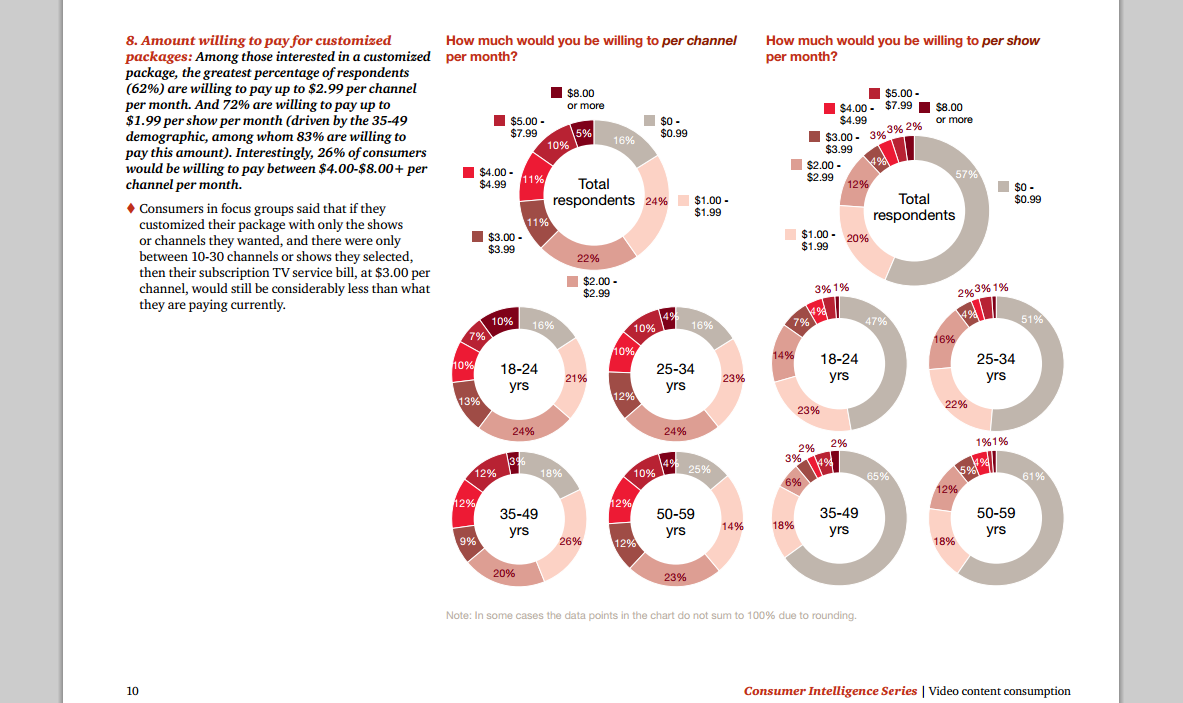
The expected pricing “per channel” is where the biggest disconnect exists. About 16 percent of respondents say they would not pay more than 99 cents a month for a channel. Some 24 percent will pay $1.99 and 22 percent will pay $2.99.


At $8 a month per channel, only about five percent of respondents indicated they would pay.


When asked about what they would pay for a single show, the survey found that 57 percent would not pay more than 99 cents a month for access to an individual show each month.


Some 20 percent indicated they would pay $1.99 for access to one TV show for a month (not per episode) and 12 percent would pay $2.99 for such access.


Only two percent would pay $8 a month for a show. If one assumes four episodes a month, tha indicates a fee of $4 per episode was considered too high.


Of respondents interested in a customized package, some 62 percent are willing to pay up to $2.99 per channel per month. About 72 percent are willing to pay up to $1.99 per show per month, driven by the 35-49 demographic, among whom 83 percent are willing to
pay this amount.


But 26 percent of consumers indicated they would be willing to pay between $4.00 to $8.00 per
channel per month.


Studies by the Federal Communications Commission seem to have concluded that unbundling could save money, or wouldn't save money, depending on how many channels a consumer buys under an a la carte regime, compared to what they buy now.


One of the studies suggested “consumers that purchase at least nine networks would likely face an increase in their monthly bills" when buying a la carte.


Likewise, one of the FCC studies suggested bill increases ranging from 14 percent to 30 percent under a la carte, while the other suggests a consumer purchasing 11 cable channels would face a change of bill ranging from a 13 percent decrease to a four percent increase, with a decrease in three out of four cases.


The point is that it is very hard to tell, conclusively, what might happen if providers shifted to a la carte viewing.

An economist might say the typical video bundle works because it allows distributors to apply scale and scope economics.


The corollary is that most networks, which are advertising supported, want to be part of a "no choice" basic tier for business reasons of their own, namely the ability to better sell the advertising that underpins their business models.


According to some studies, relatively few networks actually make a $100 million or more in annual ad revenue, though. That suggests they might have to make up the revenue shortfall some other way, in an a la carte regime.


When multichannel video distributors say a bundled approach creates economics that favor smaller, niche networks to thrive, they are right, economists might say.


Deprived of carriage on a broad "enhanced basic" tier, perhaps 60 percent of networks might find themselves immediately imperiled, as going concerns, some would estimate.


An end to bundling would likely harm most smaller, more-lightly-viewed networks. To the extent that content and program diversity is a desired end user benefit, "choice" in all likelihood would decline in a full a la carte environment, because most people would not buy most channels.


The possible advent of over-the-top TV viewing worries most in the current ecosystem for one compelling reason: "households view less than one quarter of the networks they are forced to buy in the bundle," the Consumers Union noted in an past analysis assuming a 50-channel offering.


Even today, with hundreds of available channels, end user behavior does not seem to have changed much. Most people watch a dozen or so channels on a regular basis.


And there are costs besides content fees. Cable operators have argued that end-user costs might actually climb in an a la carte environment, for a number of reasons. Higher customer care costs, operating and marketing are likely, cable operators have argued.


The point is that it is very hard to tell, conclusively, what might happen if providers shifted to a la carte viewing.


Email ThisBlogThis!Share to XShare to Facebook
Posted in | No comments
Newer Post Older Post Home

0 comments:

Post a Comment

Subscribe to: Post Comments (Atom)

Popular Posts

  • Seattle's Gigabit Squared Fails: Sustainability Remains an Issue for Muni Access Networks
    Seattle's Gigabit Squared  network appears to have failed, illustrating a recurring problem with all municipal or joint venture Internet...
  • Access Networks Increasingly are All About Video
    In North America, r eal-time entertainment is responsible for over  68 percent of downstream bytes during peak periods, compared to 65 perce...
  • Using a Drone-Mounted Camera to See what a Surfer Sees "In the Water"
    If you've ever seen a picture of a surfer (the ocean kind), shot from shore, you have one view of what's going on, but you can't...
  • New Report Confirms: Investment or Competition is a Real Issue for Access Networks
    The latest Ofcom report on U.K. broadband infrastructure illustrates the inherent tension between promoting investment in next generation ne...
  • Google Fiber in Provo Prices Same as Kansas City
    Google Fiber  in Provo, Utah will be priced the same way as Google Fiber in Kansas City. People will be able to sign up for free 5 Mbps down...
  • EC to Review Telefonica, E-Plus Merger: How Many Carriers are Needed in Germany?
    European Union antitrust regulators will examine deals such as the proposal by Telefonica and Royal KPN to combine their German assets, base...
  • AT&T Tower Sale Raises, Does Not Answer, Question of "Core Competency"
    What is AT&T’s “core competency?” That is a question observers might raise, in the wake of AT&T’s decision to sell its U.S. mobile t...
  • How Big a Phone Will You Carry All the Time?
    How big a device will you carry with you, all the time, like you carry a mobile phone? Samsung Mega is going to provide some real-world tes...
  • To Attack U.S. Mobile Pricing Structure, Sprint and T-Mobile US Will Have to AddressTheir Own Cost Structures
    If a mobile service provider wants to attack prevailing retail prices in a serious way, it also has to attack its own operating and possibly...
  • Market Disruption is a Game Verizon Can Play as Well
    One often tends to think that big market disruptions are caused by small, upstart firms. History might suggest something quite different. Y...

Blog Archive

  • ►  2014 (23)
    • ►  January (23)
  • ▼  2013 (476)
    • ►  December (83)
    • ►  November (79)
    • ▼  October (127)
      • "Coverage" Limits Telco TV Gains
      • Netflix is Bigger than HBO and Comcast, on One Mea...
      • Netflix on Comcast X1 Platform "Not a High Priorit...
      • AT&T to Bid for Vodafone?
      • Will Access Networks Lose Value in Mobile Business?
      • When Customers Like Your Service Less, the More Th...
      • Bandwidth Matters: Sprint LTE Gets 6-8 Mbps at 1.9...
      • Sprint Makes Progress in 3Q 2013
      • Sprint Might Have an Opportunty with its Clearwire...
      • NFC Will "Never" Lead U.S. Mobile Payments?
      • Tom Wheeler Confirmed by U.S. Senate as New FCC Ch...
      • 4 or 3: the Most Important Number in the Mobile Bu...
      • Intel Media Preparing to End Effort to Create Srea...
      • Google Photos, Hangouts Enhanced
      • 15 Percent of 3G/4G Tablet Owners Pay for Data Plan
      • Time Warner Cable Upgrading to 100 Mbps in Some Ma...
      • If There is a Spectrum Bubble, Does it Martter?
      • Verizon Terremark Outage Blocks Healthcare.com Access
      • Motorola Ara: Smart Phones Like Legos
      • Amazon's "Profitless" Strategy is its Strategy
      • AT&T Delays Special Access Rate Changes
      • "Harvesting" Might be All Most Service Providers c...
      • New Licensed, Unlicensed, Shared Spectrum Proposal...
      • All 4 U.S. Leading Mobile Providers Abandon Metere...
      • Google Wi-Fi Passport: One More Way Google is Enab...
      • Can You Really Compete with "Free?"
      • Comcast Tests Demand for Antenna Basic Plus HBO
      • On Fiber or Copper Access Connections, Heavy Users...
      • Increase Access Speed 1 Mbps, Consumption Grows by...
      • Ethernet Delivers Most of the Bandwidth, Special A...
      • New Report Confirms: Investment or Competition is ...
      • Telekom Austria Wins Half of LTE Spectrum
      • Tablets, U-verse Drive AT&T 3Q 2013 Results
      • Mobile and Fixed Network ISPs Face Different "Key ...
      • LinkedIn: 38% of Visits are From Mobile Devices
      • Are Tablets Now Driving Net New Mobile Service Pro...
      • Fon Launches New Router to Help Build U.S. Fon Net...
      • Walmart Launches Tablet Trade-In Program
      • A Lost Decade of Revenue in Europe
      • If Airlines are Targeting Bus Travelers, What Can ...
      • The iPhone is a Proxy for the Smart Phone Market, ...
      • iPad Drives 81% of U.S. Tablet Data Consumption
      • North America Mobile Data Forecast: At Inflection ...
      • When "Carrier Class" is a Bad Idea
      • When will Netflix Be Bigger than HBO?
      • "Harvesting" and "Sowing" Define the Service Provi...
      • Will "Premium Pricing" Work Better for Some Device...
      • Smart Phone Saturation by 2015 in France, Germany,...
      • AT&T Tower Sale Raises, Does Not Answer, Question ...
      • There's Only So Much Service Providers Can Do, to ...
      • AT&T Adds Tesla to GM OnStar "Connected Car" Access
      • Mobile Network, OTT App Provider Return on Investe...
      • LTE Deployment Activity Moving to Asia-Pacific, La...
      • Tablets Not Replacements for PCs, Generally Speaking
      • U.S. Connected Device (Tablet, E-Reader) Adoption 43%
      • $22 Billion in M2M Revenues in 2017
      • Google Core Revenue Driver Now is Advertising; Cou...
      • 41 Percent of YouTube Viewing is on Mobiles
      • Mobile Customers, Accounts, Lines, Devices: What a...
      • Scratch Wireless Launches with "Wi-Fi First" Acces...
      • America Movil Abandons KPN Acquisition Effort
      • Google Fiber Adds ESPN, Disney Streaming for Smart...
      • Mobile Is Reaching Parity with Online Content Cons...
      • Mobile Data Volume Mostly Carried on Fixed Networks
      • Does Mobile Broadband "Cause" Economic Growth?
      • U.S. Mobile Business Becoming a Price Game?
      • How Much Video Piracy is Caused by Lack of Legal S...
      • Amazon Working on Smart Phone with HTC
      • Verizon Wireless Tests 80-Mbps Service in Manhattan
      • How Much Difference Will LTE Make in U.K. Market?
      • Is Nokia a Metaphor for European Mobile Business?
      • How Big a Problem are Smart Phone Device Subsidies?
      • U.S. Mobile Service Prices Actually are Quite Low
      • Structural or Cyclical Problems?
      • Australia to Study Impact of Broadband: Issue Real...
      • Do Phablets Cannibalize Tablet Sales?
      • Canadian Lawmakers to Introduce "A La Carte" Plan
      • LTE a 'Huge Opportunity' in Europe?
      • Netflix Move Complicates "Internet TVs"
      • Dumb Networks, Smart Networks and SDN
      • PayPal Beacon: Zero Touch Retail Payments
      • Mobile Service Providers Now are ISPs, Voice and T...
      • Mobile Market Might Require More Sophisticated Reg...
      • Voice had a Life Cycle; Does TV Also Have a Life C...
      • Cable Needs Content Buying Entity, and its Own Net...
      • CenturyLink to Deploy 1-Gbps Network to a Few Thou...
      • 34% of Millennials Do Not Watch Broadcast TV
      • New Markets Often are a Zero-Sum Game: Some Winner...
      • Peak Mobile Revenue in 2017?
      • What Market are Dish Network, DirecTV In?
      • U.K. Mobile Operators Face New £244.5 Million in A...
      • No Challengers in Belgium 800-MHz Spectrum Auction
      • Some Regulators Want More Investment, But European...
      • Mobile Internet Access Drives Telecom Industry Growth
      • Mobile TV Winners and Losers
      • In-App Purchases are Becoming a Dominant Mobile Ap...
      • Why Budgets Matter: Debt Load is "Unsustainable"
      • Huawei, Nokia in Top-4 Hanset Sales Ranks, But Sam...
      • Are U.S. Mobile Prepaid Data Plans Really Out of W...
      • NTT DoCoMo Sees Record Monthly Drop in Subscriptions
    • ►  September (95)
    • ►  August (92)
Powered by Blogger.

About Me

Unknown
View my complete profile