Broad Soft

  • Subscribe to our RSS feed.
  • Twitter
  • StumbleUpon
  • Reddit
  • Facebook
  • Digg

Monday, 7 October 2013

Are U.S. Mobile Prepaid Data Plans Really Out of Whack?

Posted on 14:33 by Unknown
There is a recurring problem when comparing Internet access or mobile data costs across countries, beyond the obvious problem that all local prices are meaningful primarily in relation to other consumer goods in any particular country. In other words, wealthier countries are going to have higher prices for just about anything.  

The other problem is that when making a comparison of rates, one has to make a choice about what sorts of plans to compare. Prepaid mobile is the dominant way most end users in the world buy their service. But that is not the way most people buy service in most parts of North America, with the exception of Central America, where prepaid is dominant.  

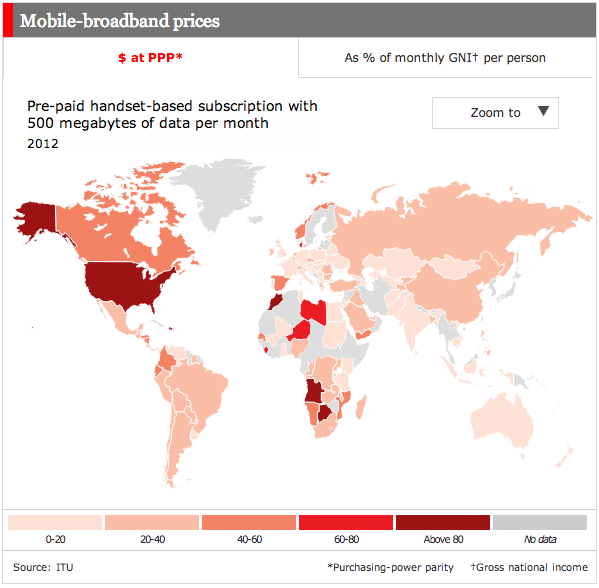
In terms of “actual” prices, prepaid prepaid mobile data data plans in the United States are among the highest in the world, an International Telecommunication Union study suggests.

The average prepaid U.S. phone plan with 500 MB of data costs $85 in the United States, compared to $24.10 in China and $8.80 in the U.K., in terms of U.S. dollar Purchasing-power Parity (PPP).

Whether those findings are correct, some will contest. The issue is that most people do not buy prepaid plans in the United States. And the new Target brightspot service, for example, costs just $50 a month, and comes with unlimited domestic voice, text messaging and mobile data access, with 1 Gb of data access on T-Mobile US 4G networks (HSPA+ and Long Term Evolution), the balance on T-Mobile's 3G data network.

Beyond that, one might question which U.S. prepaid data plans were chosen for analysis, as some of us would have a tough time finding prepaid plans with charges that high, even if the selected plans were those available only to consumers with no credit history and no banking relationships.

According to the analysis, the cheapest countries around the world to pick up a prepaid phone plan with data are India, Indonesia, Germany, Italy and the U.K, where $10 plans (PPP) cost $85 in the United States.

That aside, the more important insight is simply that prices make sense mostly within the context of all other goods and services in a single country.

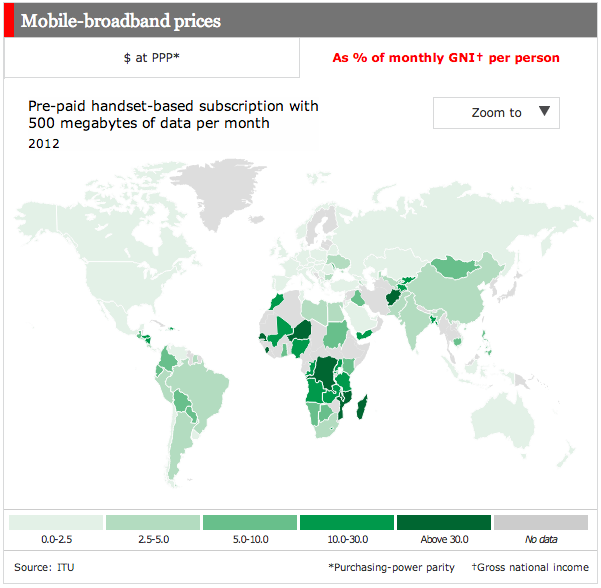
Even if you accept the logic that the prepaid data plans are high, and ignoring the fact that most consumers do not buy those plans, that $85 phone plan is just 2.1 percent of the Gross National Income in the United States, whereas in Botswana the cost of a prepaid mobile data plan  is nine percent of GNI, and in Morocco is 20 percent of GNI.

Using even the ITU data for mobile prepaid (and that is not the best way to look at U.S. mobile data plans, since most people do not buy prepaid) U.S. prepaid prices are comparable to Canada, Mexico, most all of Europe and Russia, one might argue.


Email ThisBlogThis!Share to XShare to Facebook
Posted in | No comments
Newer Post Older Post Home

0 comments:

Post a Comment

Subscribe to: Post Comments (Atom)

Popular Posts

  • Seattle's Gigabit Squared Fails: Sustainability Remains an Issue for Muni Access Networks
    Seattle's Gigabit Squared  network appears to have failed, illustrating a recurring problem with all municipal or joint venture Internet...
  • All 4 U.S. Leading Mobile Providers Abandon Metered Voice
    With a recent move by AT&T, all four of the leading U.S. mobile service providers now offer the overwhelming number of subsctribers serv...
  • Smart Phone Shipments Will Be 82% of All Handset Sales in 2017
    Global smartphone shipments are forecast to reach 1.8 billion in 2017, accounting for 82 percent of total mobile phone handset shipments, up...
  • Can "Internet Access" Be More Than a Commodity?
    What makes today’s “Internet access” different from voice, text messaging or video entertainment? The answer explains why service providers ...
  • U.K. Looks for 650 MHz More Wi-Fi and Mobile Spectrum
    U.K. communications regulator Ofcom is investigating ways to free up up more mobile broadband and Wi-Fi spectrum over the next decade or two...
  • Above-Average Economic Growth in "Developing" Regions Will Drive Communications Growth as Well
    Generally speaking, consumption of communications products and services tracks gross domestic product. So it makes a great deal of differenc...
  • Mobile Business Now Faces "End of Growth" Driven by Subscriber Adds
    In the second quarter of 2013, U.S. mobile service providers added an aggregate net new 139,000 connections, down about 95 percent from the ...
  • Telekom Austria Wants to Buy Serbia Broadband
    Telekom Austria wants to buy cable operator Serbia Broadband, a deal that might cost as much as  1 billion euros ($1.3 billion), and illustr...
  • America Movil Encounters Obstacle in Effort to Buy KPN
    America Movil , which has made an offer to buy Netherlands service provider KPN, has encountered an obstacle. A KPN shareholder foundation s...
  • Telenor Users to Get Free Wikipedia Access in Myanmar
    Myanmar is the latest country where mobile phone users will be able to get mobile access to Wikipedia free of charge (without paying data pl...

Blog Archive

  • ►  2014 (23)
    • ►  January (23)
  • ▼  2013 (476)
    • ►  December (83)
    • ►  November (79)
    • ▼  October (127)
      • "Coverage" Limits Telco TV Gains
      • Netflix is Bigger than HBO and Comcast, on One Mea...
      • Netflix on Comcast X1 Platform "Not a High Priorit...
      • AT&T to Bid for Vodafone?
      • Will Access Networks Lose Value in Mobile Business?
      • When Customers Like Your Service Less, the More Th...
      • Bandwidth Matters: Sprint LTE Gets 6-8 Mbps at 1.9...
      • Sprint Makes Progress in 3Q 2013
      • Sprint Might Have an Opportunty with its Clearwire...
      • NFC Will "Never" Lead U.S. Mobile Payments?
      • Tom Wheeler Confirmed by U.S. Senate as New FCC Ch...
      • 4 or 3: the Most Important Number in the Mobile Bu...
      • Intel Media Preparing to End Effort to Create Srea...
      • Google Photos, Hangouts Enhanced
      • 15 Percent of 3G/4G Tablet Owners Pay for Data Plan
      • Time Warner Cable Upgrading to 100 Mbps in Some Ma...
      • If There is a Spectrum Bubble, Does it Martter?
      • Verizon Terremark Outage Blocks Healthcare.com Access
      • Motorola Ara: Smart Phones Like Legos
      • Amazon's "Profitless" Strategy is its Strategy
      • AT&T Delays Special Access Rate Changes
      • "Harvesting" Might be All Most Service Providers c...
      • New Licensed, Unlicensed, Shared Spectrum Proposal...
      • All 4 U.S. Leading Mobile Providers Abandon Metere...
      • Google Wi-Fi Passport: One More Way Google is Enab...
      • Can You Really Compete with "Free?"
      • Comcast Tests Demand for Antenna Basic Plus HBO
      • On Fiber or Copper Access Connections, Heavy Users...
      • Increase Access Speed 1 Mbps, Consumption Grows by...
      • Ethernet Delivers Most of the Bandwidth, Special A...
      • New Report Confirms: Investment or Competition is ...
      • Telekom Austria Wins Half of LTE Spectrum
      • Tablets, U-verse Drive AT&T 3Q 2013 Results
      • Mobile and Fixed Network ISPs Face Different "Key ...
      • LinkedIn: 38% of Visits are From Mobile Devices
      • Are Tablets Now Driving Net New Mobile Service Pro...
      • Fon Launches New Router to Help Build U.S. Fon Net...
      • Walmart Launches Tablet Trade-In Program
      • A Lost Decade of Revenue in Europe
      • If Airlines are Targeting Bus Travelers, What Can ...
      • The iPhone is a Proxy for the Smart Phone Market, ...
      • iPad Drives 81% of U.S. Tablet Data Consumption
      • North America Mobile Data Forecast: At Inflection ...
      • When "Carrier Class" is a Bad Idea
      • When will Netflix Be Bigger than HBO?
      • "Harvesting" and "Sowing" Define the Service Provi...
      • Will "Premium Pricing" Work Better for Some Device...
      • Smart Phone Saturation by 2015 in France, Germany,...
      • AT&T Tower Sale Raises, Does Not Answer, Question ...
      • There's Only So Much Service Providers Can Do, to ...
      • AT&T Adds Tesla to GM OnStar "Connected Car" Access
      • Mobile Network, OTT App Provider Return on Investe...
      • LTE Deployment Activity Moving to Asia-Pacific, La...
      • Tablets Not Replacements for PCs, Generally Speaking
      • U.S. Connected Device (Tablet, E-Reader) Adoption 43%
      • $22 Billion in M2M Revenues in 2017
      • Google Core Revenue Driver Now is Advertising; Cou...
      • 41 Percent of YouTube Viewing is on Mobiles
      • Mobile Customers, Accounts, Lines, Devices: What a...
      • Scratch Wireless Launches with "Wi-Fi First" Acces...
      • America Movil Abandons KPN Acquisition Effort
      • Google Fiber Adds ESPN, Disney Streaming for Smart...
      • Mobile Is Reaching Parity with Online Content Cons...
      • Mobile Data Volume Mostly Carried on Fixed Networks
      • Does Mobile Broadband "Cause" Economic Growth?
      • U.S. Mobile Business Becoming a Price Game?
      • How Much Video Piracy is Caused by Lack of Legal S...
      • Amazon Working on Smart Phone with HTC
      • Verizon Wireless Tests 80-Mbps Service in Manhattan
      • How Much Difference Will LTE Make in U.K. Market?
      • Is Nokia a Metaphor for European Mobile Business?
      • How Big a Problem are Smart Phone Device Subsidies?
      • U.S. Mobile Service Prices Actually are Quite Low
      • Structural or Cyclical Problems?
      • Australia to Study Impact of Broadband: Issue Real...
      • Do Phablets Cannibalize Tablet Sales?
      • Canadian Lawmakers to Introduce "A La Carte" Plan
      • LTE a 'Huge Opportunity' in Europe?
      • Netflix Move Complicates "Internet TVs"
      • Dumb Networks, Smart Networks and SDN
      • PayPal Beacon: Zero Touch Retail Payments
      • Mobile Service Providers Now are ISPs, Voice and T...
      • Mobile Market Might Require More Sophisticated Reg...
      • Voice had a Life Cycle; Does TV Also Have a Life C...
      • Cable Needs Content Buying Entity, and its Own Net...
      • CenturyLink to Deploy 1-Gbps Network to a Few Thou...
      • 34% of Millennials Do Not Watch Broadcast TV
      • New Markets Often are a Zero-Sum Game: Some Winner...
      • Peak Mobile Revenue in 2017?
      • What Market are Dish Network, DirecTV In?
      • U.K. Mobile Operators Face New £244.5 Million in A...
      • No Challengers in Belgium 800-MHz Spectrum Auction
      • Some Regulators Want More Investment, But European...
      • Mobile Internet Access Drives Telecom Industry Growth
      • Mobile TV Winners and Losers
      • In-App Purchases are Becoming a Dominant Mobile Ap...
      • Why Budgets Matter: Debt Load is "Unsustainable"
      • Huawei, Nokia in Top-4 Hanset Sales Ranks, But Sam...
      • Are U.S. Mobile Prepaid Data Plans Really Out of W...
      • NTT DoCoMo Sees Record Monthly Drop in Subscriptions
    • ►  September (95)
    • ►  August (92)
Powered by Blogger.

About Me

Unknown
View my complete profile